
7 Manifestation Techniques That Actually Work: A Practical Guide to Turning Intentions Into Reality
The right technique does not replace effort. It helps you see what matters, and then do something about it.
⚡ Quick Summary
- Manifestation techniques work as tools for clarity, reflection and action, not as guarantees.
- Seven methods: visualisation, affirmations, scripting, the 369 method, vision boards, gratitude and if-then planning.
- Mental contrasting with if-then plans has the strongest research support of the seven.
- The 369 method is a modern popular routine. Its Tesla connection is unverified.
- Start with one or two techniques, test them for a week and keep what leads to action.
- No technique can control another person’s feelings, choices or consent.
Why Do Some Manifestation Techniques Feel Powerful but Produce Little Change?
She has tried everything. And she still does not know what to do on Monday.
Call her Nandini. (She is an illustration, not a real client, but you may recognise her.) She has filled a notebook with affirmations, built a vision board from magazine cuttings and followed a viral routine for three weeks. Each session feels good. Then the session ends, and her life looks the same as before.
Nothing is wrong with Nandini. The problem is the job she has given each manifestation technique. She expects them to do the work. They can only support it.
Manifestation techniques are popular because they offer something real: a few quiet minutes with your own goals. People expect a spark, a signal or a result. What they usually get is a clearer mind, and that is valuable if it leads somewhere. A reflective practice such as journaling is not the same as a tested psychological intervention, and this guide keeps the two apart.
Here you will find seven methods, how to practise each, what it can and cannot do, and a seven-day plan for trying them. One line first: no technique guarantees money, love, a job or any other outside result. What the right one can do is help you choose a goal, prepare for obstacles and take the next step. For the wider background, see our pillar article on how manifestation works.
What Are Manifestation Techniques?
Understanding the Meaning of a Manifestation Technique
A manifestation technique is a structured practice for focusing attention, clarifying an intention or reinforcing a direction. It might be writing, imagining, repeating a phrase, sitting quietly or planning.
Some come from modern self-help culture. Others echo older contemplative traditions. And the same technique can be used well or badly: a vision board can be a planning tool or a wall decoration.
How Manifestation Techniques May Help
Realistically, a technique can help you in seven ways: clarifying priorities, raising awareness of what you want, prompting reflection, supporting motivation, making plans concrete, reinforcing repeated behaviours and reviewing progress. Every item on that list is something that happens in you. None happens in the economy, in a stranger’s mind or in the weather.
What Manifestation Techniques Cannot Guarantee
- They cannot make another person feel, choose or behave in a particular way.
- They cannot ensure wealth, a job, a relationship or a deadline.
- They cannot remove external barriers on their own.
- They cannot replace medical, psychological, legal or financial advice.
- They should never be used to blame someone for illness, hardship or circumstances beyond their control.
7 Manifestation Techniques That Actually Work
For each method, you will find what it is, how to practise it, an example and its limits. Keep the limits in mind. They are what keep the techniques honest.
Technique 1 — Visualisation: Mentally Rehearse the Process of Success
Visualisation means forming a clear mental picture of something you plan to do. Outcome visualisation pictures the result: the offer letter, the finished race. Process visualisation pictures the steps: preparing, arriving, speaking, coping when it gets hard.
Mental rehearsal is used in learning, sport and professional preparation. A 1994 meta-analysis by Driskell, Copper and Moran found that mental practice could improve performance, with effects that varied by task and were strongest for tasks with a large thinking component. It complements physical practice. It does not replace it. And research suggests that imagining only the reward can sap effort, which is why the process matters more than the prize.
- Choose one specific goal.
- Identify one realistic action that contributes to it.
- Spend a few minutes imagining yourself carrying out that action.
- Include likely challenges and how you would respond.
- Do the action in real life.
Example: Before a job interview, picture yourself entering the room, listening carefully, answering clearly and asking a thoughtful question.
Limitation: Visualisation does not replace preparation, skill or practice, and imagining an outcome does not make it inevitable.
Technique 2 — Positive Affirmations: Build More Constructive Self-Talk
An affirmation is a short statement you repeat to shape how you think about yourself or a goal. The key word is credible. A statement your mind rejects tends to start an argument, not a belief. In a 2009 study, Joanne Wood and colleagues found that people with low self-esteem felt worse after repeating “I am a lovable person” than people who did not.
So aim for statements that are specific, believable and tied to something you can do.
| Less useful statement | More constructive affirmation |
|---|---|
| “I will become rich overnight.” | “I can improve my financial decisions and develop valuable skills.” |
| “Everyone must love me.” | “I can build relationships based on mutual respect and honesty.” |
| “I never make mistakes.” | “I can learn from mistakes and improve with practice.” |
| “Success will come without effort.” | “I can take consistent steps towards meaningful goals.” |
- Notice a recurring unhelpful thought.
- Write a balanced, constructive alternative.
- Keep it specific and believable.
- Repeat it during a short daily reflection.
- Choose one action that supports the statement.
Limitation: Affirmations guarantee nothing, and exaggerated ones can feel false. Pair every statement with a behaviour.
Technique 3 — Scripting: Write a Clear Picture of the Life You Want to Build
Scripting, in today’s manifestation culture, means writing about your future in the present tense, as a journal entry. Treat it as a reflection exercise. Writing “I run a thriving business” does not cause a business to exist. Writing it can show you what you actually want.
The best scripts describe values, routines and decisions, not only possessions. A person who writes only about a business’s success learns little. A person who writes about the skills, customer service and financial discipline behind it learns what to practise.
- Choose one area of life.
- Describe a realistic, meaningful future in a short entry.
- Include the habits and decisions that support it.
- Mark what is within your control.
- Turn one line into a task for the coming week.
Limitation: Scripting is a planning exercise, not evidence that present-tense writing causes events.
Technique 4 — The 369 Method: Understand the Popular Number-Based Writing Routine
The 369 method is a popular online routine in which you write a chosen intention three times in the morning, six times during the day and nine times in the evening. Versions differ from source to source: some use afternoon and night, some add a short phrase or a gratitude line.
The routine is often linked to Nikola Tesla. Tesla did have documented fascination with the number three. But the famous quotation about 3, 6 and 9 being the key to the universe has no definitive source, according to historians, and the manifestation routine is a modern development. Treat the Tesla story as lore, not history.
- Choose one specific intention.
- Write it three times in the morning.
- Write it six times during the day.
- Write it nine times in the evening.
- Review it and name one practical action.
This is one popular version, not a universal or historically established rule.
Used honestly, it is a structured writing habit: three touchpoints a day with the same goal. That repetition may keep a goal in view. The numbers themselves carry no proven power.
Limitation: There is no scientific evidence that writing a statement a certain number of times causes an external event. Do not attach scientific properties to 3, 6 or 9.
Technique 5 — Vision Board: Make Your Goals Visible
A vision board is a collage of images, words and symbols that represent your goals, made on paper or on a screen. Its honest function is a reminder.
Choose images for meaningful goals, not only luxury outcomes. Add the steps and skills on the way: a course, a savings milestone, a weekly habit. Keep the board small and revisit it as your priorities change.
- Choose up to three meaningful priorities.
- Select images, words or symbols for each.
- Add practical reminders of the actions needed.
- Place the board where you will see it.
- Review it weekly and update it when needed.
Example: A career board might hold a qualification, a portfolio milestone, a networking goal and a realistic work-life routine.
Limitation: A vision board is a reminder, not a prediction. It cannot stand in for a plan.
Technique 6 — Gratitude Journaling: Shift Attention Towards What Is Already Meaningful
Gratitude journaling means regularly writing down what you appreciate. It is different from forced positivity. You are not asked to feel fine. You are asked to notice what already supports you, so a hard season does not erase everything good.
Research on gratitude exercises is encouraging but modest. In a well-known 2003 experiment, Emmons and McCullough found that people who kept weekly gratitude lists reported better wellbeing than comparison groups. Later reviews have generally found small-to-moderate benefits that vary between people and studies. Gratitude can help with perspective and mood. It is not a route to a particular outcome.
Each day, write:
- One thing you genuinely appreciate.
- One action or achievement you are proud of.
- One person, resource or experience that has supported you.
- One thing you want to improve tomorrow.
Example: Someone working towards financial stability records a small saving, a lesson learned and a practical step taken that day.
Limitation: Gratitude does not erase hardship. People are allowed to acknowledge difficult emotions honestly.
Technique 7 — Mental Contrasting and If-Then Planning: Connect Your Goal With a Realistic Action Plan
This is the best-grounded technique on the list. Mental contrasting, developed by psychologist Gabriele Oettingen, asks you to imagine a desired future and then look honestly at what stands in the way. Implementation intentions, studied by Peter Gollwitzer, add an if-then plan: “If this happens, then I will do that.”
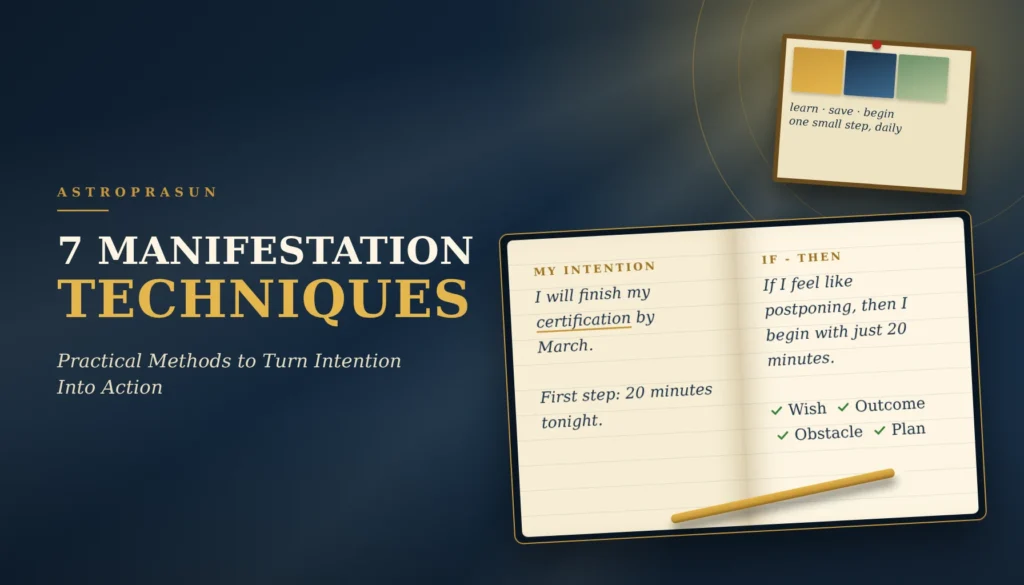
Together they are sometimes taught as WOOP: Wish, Outcome, Obstacle, Plan. A 2006 meta-analysis by Gollwitzer and Paschal Sheeran, covering 94 studies, found that if-then plans had a medium-to-large effect on goal attainment. Effects vary with context, and they do not guarantee success. But this is the opposite of passive positive thinking. It makes you face the obstacle before it arrives.
- Wish: Identify a meaningful goal.
- Outcome: Describe the most important benefit of achieving it.
- Obstacle: Name the main obstacle in your circumstances or behaviour.
- Plan: Write an if-then response.
Example: Wish: complete a professional certification. Outcome: more knowledge and better career options. Obstacle: postponing study after work. Plan: “If I finish dinner and feel tempted to postpone studying, then I will complete a 20-minute study session before relaxing.”
A technique is only as useful as the next step it makes you take. — Prosun Dey · AstroPrasun
Which Manifestation Technique Should You Choose?
There is no single best method. Match the technique to the need.
| Your need | Technique to consider | Practical purpose |
|---|---|---|
| Clarifying a goal | Scripting | Organise thoughts and priorities |
| Preparing for a performance | Process visualisation | Mentally rehearse relevant actions |
| Improving self-talk | Realistic affirmations | Practise constructive thinking |
| Remembering priorities | Vision board | Keep goals visible |
| Reflecting on progress | Gratitude journal | Notice support and small achievements |
| Addressing procrastination | Mental contrasting + if-then | Prepare for obstacles |
| Building a reflection habit | 369 writing routine | Create a consistent journaling structure |
The 369 method appears here as a popular cultural practice. Its number pattern has not shown any special causal power.
How to Use Manifestation Techniques for Different Life Goals
Manifestation Techniques for Money and Financial Goals
Use scripting to define what financial stability means to you. Use affirmations to support constructive habits, a vision board to remember savings and learning goals, and if-then plans to manage spending or protect a study routine. Then connect every intention to a real decision: the transfer, the invoice, the budget. Techniques support those choices. They do not replace them.
Manifestation Techniques for Love and Relationships
Journal to understand your values. Use affirmations to strengthen self-respect and healthy boundaries. Visualise yourself listening with empathy and communicating clearly. Look for patterns in past relationships. And respect that another person’s autonomy, choices and consent cannot be manifested away.
Manifestation Techniques for Career and Professional Success
Visualise the process of preparing for an interview or presentation. Script to clarify direction. Use affirmations to encourage learning and persistence, and if-then plans for procrastination. Turn the vision board into a reminder of skills and milestones.
Manifestation Techniques for Personal Growth
Gratitude journaling supports reflection. Scripting reveals values. Visualisation lets you rehearse a habit, and an if-then plan makes it easier to repeat. Review progress without demanding perfection.
A Simple 7-Day Manifestation Practice for Beginners
This plan lets you test the techniques in a week. Treat it as an experiment, not a promise.
| Day | Practice | Suggested task |
|---|---|---|
| Day 1 | Goal clarity and scripting | Write one meaningful goal and why it matters |
| Day 2 | Realistic affirmations | Identify and reframe one unhelpful thought |
| Day 3 | Process visualisation | Mentally rehearse one useful action |
| Day 4 | Vision board | Create a small visual reminder of the goal and its steps |
| Day 5 | Gratitude journaling | Record meaningful support and progress |
| Day 6 | Mental contrasting | Identify the main obstacle and prepare an if-then plan |
| Day 7 | Reflection | Review what helped and choose a sustainable routine |
A Simple Daily 15-Minute Routine
| Duration | Practice |
|---|---|
| 3 minutes | Read your goal and intention |
| 3 minutes | Practise realistic affirmations |
| 3 minutes | Visualise a useful action |
| 3 minutes | Review an obstacle and your response |
| 3 minutes | Record gratitude and the next step |
You do not need to use every method forever. Keep what is useful, manageable and tied to real action. Drop the rest without guilt.
Common Mistakes People Make When Using Manifestation Techniques
- Trying too many techniques at once. Begin with one or two and judge their usefulness.
- Expecting instant results. Allow realistic time for learning, practice and outside processes.
- Repeating affirmations without changing behaviour. Tie each statement to a concrete action.
- Visualising only the final reward. Rehearse the process and the likely obstacles.
- Treating a vision board as a guarantee. Use it as a reminder, not a prediction.
- Using scripting to avoid difficult decisions. Convert insights into practical steps.
- Blaming yourself when an outcome does not happen. Recognise factors beyond your control.
- Following viral methods without understanding them. Question claims and avoid unsupported promises.
Do Manifestation Techniques Really Work? What Does Science Say?
Some of the processes behind these techniques are well studied. The popular claims built on top of them often are not. Here is the difference, one technique at a time.
What Research Says About Mental Rehearsal
Mental practice can improve performance in many tasks, but the effect depends on the task, and it generally complements actual practice. In the Driskell et al. meta-analysis, benefits were reported mainly for tasks with a large cognitive element, among novices, and with shorter mental practice sessions. It is a tool for preparation, not a substitute.
What Research Says About Affirmations
Not all affirmation routines have the same evidence. Self-affirmation research, reviewed by Geoffrey Cohen and David Sherman in 2014, usually asks people to reflect on their core values, for example by writing about what matters most to them. That differs from repeating a wished-for outcome. Wood’s 2009 study shows how the second kind can backfire for some people. Values-based reflection and “I will be rich” are two different things.
What Research Says About Gratitude Practices
Reviews of gratitude interventions generally report small-to-moderate benefits for wellbeing, and results differ between individuals and designs. It is a reasonable reflective habit, with limited claims.
Why Mental Contrasting and If-Then Planning Are Worth Understanding
Of the seven techniques, this pairing has the most robust research on goal pursuit. Oettingen’s work on mental contrasting and the Gollwitzer and Sheeran meta-analysis both point the same way: pairing a desired future with a realistic look at obstacles, and a prepared response, helps people follow through. The effects vary by person and context.
The Difference Between Psychological Benefits and Supernatural Claims
- A technique may help clarify a goal.
- A technique may encourage useful reflection.
- A technique may support preparation or behaviour.
- These effects do not prove that thoughts directly attract external events.
- Outcomes also depend on circumstances, resources, other people and chance.
What Indian Spiritual Wisdom Can Add to Your Manifestation Practice
Modern manifestation trends are not the same thing as ancient teachings, and it would be misleading to pretend otherwise. But Indian philosophy has long explored intention, action and attention, and four of its ideas fit this practice well.
Sankalpa — Setting a Considered Intention
Sankalpa (SUN-kul-pa) means a deliberate resolve. In Kolkata, where Durga Puja begins with a sankalpa spoken by the priest, naming who is performing the ritual and for what purpose, the idea is familiar: an intention stated with clarity and commitment. A casual wish says “I hope”. A sankalpa says “I commit”. A short sentence read each morning can serve the same purpose in your own practice.
Karma — Why Action Matters
Karma (KAR-ma) literally means action. In Indian thought, intention shapes conduct and conduct has consequences, which puts responsibility on the person acting. A spiritual practice that leaves you waiting is misusing the word. The Bhagavad Gita (2.47) asks you to act fully without clinging to the fruit.
Swadharma — Choose Goals That Reflect Your Values and Responsibilities
Swadharma (sva-DHAR-ma) means one’s own duty or nature. Historically it was linked to social roles. Read in a modern way, it asks about your values, strengths and responsibilities. Gita 3.35 says it is better to follow your own path imperfectly than another’s perfectly. Copying someone else’s definition of success makes any technique harder to sustain, because the goal was never yours.
Meditation and Self-Observation
Indian contemplative traditions treat meditation as training in attention and observation. Patanjali’s Yoga Sutras (1.2) define yoga as the stilling of the fluctuations of the mind, though translations vary. In practice, meditation can help you notice a thought without automatically obeying it, which makes your choices more considered. It does not guarantee manifestation.
If you enjoy exploring self-understanding tools, you may also like our guides to Vedic name numerology, astrology and numerology and the different numerology systems. They work as mirrors for reflection, not as promises of outcomes.
Final Thoughts — Choose the Technique That Helps You Take the Next Step
You do not need to follow every trend or perform elaborate rituals. A vision board may remind you of a priority. Journaling may clarify it. Visualisation may help you rehearse a task, and an if-then plan may help you respond when procrastination appears.
The value of a technique lies not in a promise of guaranteed results, but in how responsibly and consistently it supports your choices and behaviour.
So choose one technique today. Practise it consistently for a week. Then decide whether it is useful.
Frequently Asked Questions About Manifestation Techniques
What are the most effective manifestation techniques?
The techniques with the strongest research behind them are mental contrasting with if-then planning and process-focused visualisation, because both connect a goal to preparation and action. Gratitude journaling, realistic affirmations, scripting and vision boards can support focus and motivation. No technique guarantees an external result, so choose the ones that move you to act.
How do beginners start manifesting?
Beginners should start with one goal and one technique, such as writing a short intention each morning and completing one related action. Add a second method, for example a gratitude entry at night, only after a week. The seven-day practice in this guide offers a gentle way to test each technique without overwhelm.
Does the 369 manifestation method really work?
There is no scientific evidence that writing an intention 3, 6 and 9 times causes an outside event to happen. The method can work as a structured writing habit that keeps a goal in view and prompts you to act. The popular link to Nikola Tesla rests on a quotation historians have not been able to source.
How many times should I write my manifestation?
Write it as often as it helps you stay clear and take action, because no number of repetitions is scientifically required. Once a day is enough for most people. If you enjoy the 369 routine, use it as a habit structure, then finish by naming one practical step you will take today.
Is visualisation better than affirmations?
Neither is better in every case; they do different jobs. Visualisation, particularly of the process and likely obstacles, helps you rehearse actions. Affirmations help you practise more constructive self-talk, and they work best when credible. For preparing for something specific, such as an interview, process visualisation is usually the more useful choice.
Can manifestation techniques help attract money?
They can help you act more clearly on money goals, but they cannot guarantee income. Scripting can define what financial stability means to you, and if-then plans can protect savings or learning habits. Real change still depends on skills, earnings, spending decisions and circumstances. Seek qualified financial advice for major decisions.
How long should I practise manifestation techniques?
Try one technique consistently for about a week, then decide whether it is useful. If it helps you act, continue as long as it serves you. There is no fixed number of days that makes manifestation work. Keep the practices that are manageable and connected to real action.
Can I use more than one manifestation technique at a time?
Yes, and combining them often works better than relying on one. A sensible pairing is scripting to clarify a goal, process visualisation to rehearse a step and an if-then plan to handle the main obstacle. Add techniques gradually, because too many at once can turn practice into a chore.
Sources and Further Reading
- Driskell, J. E., Copper, C., & Moran, A. (1994). Does mental practice enhance performance? Journal of Applied Psychology, 79(4), 481–492. Discussion: Schuster, C., et al. (2011). Best practice for motor imagery. BMC Medicine, 9, 75.
- Wood, J. V., Perunovic, W. Q. E., & Lee, J. W. (2009). Positive self-statements: Power for some, peril for others. Psychological Science, 20(7), 860–866. Coverage: National Geographic.
- Cohen, G. L., & Sherman, D. K. (2014). The psychology of change: Self-affirmation and social psychological intervention. Annual Review of Psychology, 65, 333–371. Publication page.
- Emmons, R. A., & McCullough, M. E. (2003). Counting blessings versus burdens. Journal of Personality and Social Psychology, 84(2), 377–389.
- Gollwitzer, P. M., & Sheeran, P. (2006). Implementation intentions and goal achievement: A meta-analysis of effects and processes. Advances in Experimental Social Psychology, 38, 69–119.
- Oettingen, G. (2014). Rethinking Positive Thinking: Inside the New Science of Motivation. Current.
- On the 369 method and the unverified Tesla quotation: Mental Floss.
- Bhagavad Gita 2.47 and 3.35; Patanjali, Yoga Sutras 1.2. Compare more than one translation.
Understand Your Own Starting Point
Clear intention begins with self-understanding. Calculate your Life Path Number as a prompt for reflection, or explore a personal reading from AstroPrasun if you would like guidance from a practitioner.
📞 Call/WhatsApp: +91-9233309796 · 📧 contact@astroprasun.com · Contact page

Deep Focus: How to Build Discipline, Master Concentration and Enter Flow
✦ Psychology · Productivity · Self-Mastery Deep Focus: How to Build Discipline, Master Concentration and…
7 Manifestation Techniques That Actually Work
✦ Manifestation · Practical Methods · Self-Growth 7 Manifestation Techniques That Actually Work: A Practical…

How to Manifest Anything You Want: 7 Practical Steps
✦ Manifestation · Practical Spirituality · Self-Growth How to Manifest Anything You Want: 7 Practical…

How Manifestation Works: Science & Upanishads
✦ Spirituality · Vedic Wisdom · Self-Discovery How Manifestation Works: What Science and the Upanishads…

Seeing Snakes in Dreams Meaning
✦ Dreams · Hindu Symbolism · Vedic Astrology Seeing Snakes in Dreams Meaning: Hindu Tradition,…

Auspicious Muhurtha: Select the Right Time | AstroPrasun
✦ Jyotish · Muhurtha · Vedic Electional Astrology Auspicious Muhurtha: How to Select the Right…