
How to Manifest Anything You Want: 7 Practical Steps That Actually Work
A wish gives you a direction. An intention, a plan and a daily habit get you moving along it.
⚡ Quick Summary
- Manifestation works best as a process: clear intention, honest preparation and consistent action.
- The seven steps are clarity, mindset, visualisation, obstacles, action, gratitude and detachment.
- Picture the process as well as the result. Picturing success alone can lower your effort.
- If-then plans turn good intentions into behaviour, and they have strong research support.
- The Brihadaranyaka Upanishad links desire, resolve, deed and result. The Gita asks for effort without anxiety about the fruit.
- No method guarantees an external result. Use the 30-day plan to build the habit, not to chase a deadline.
Why Do Some People Get Closer to Their Dreams While Others Remain Stuck?
Two people want the same thing. A year later, one is much closer to it and the other is exactly where she started.
Call them Asha and Maya. Both are in their early thirties and both want financial independence: work they control, income they can rely on and a little breathing room. (They are illustrations, not real clients. You probably know someone like each of them, and you may have been both.)
Asha pins a photograph of a sunlit home office above her desk. Every morning she closes her eyes and imagines the life she wants, and for ten minutes she feels wonderful. Then she opens her phone and the day takes over. Twelve months later the photograph has faded and not much else has changed.
Maya starts with one plain sentence: in eighteen months, I want my own design work to cover my living costs. She finds out which skill she lacks, enrols in a weekly course and sends three pitches every Friday. She decides in advance what she will do on tired evenings. Some weeks she misses the plan. A year later she has four paying clients, a small portfolio and a much clearer idea of what works. She has no guarantee of a fifth.
The gap between them is not luck or magic. Asha has a wish. Maya has an intention, a plan and a habit. That difference is the subject of this guide.
In practical terms, manifestation is the process of turning a clear desire into a decision, and a decision into sustained action. Your thoughts, beliefs and attention shape what you notice, what you choose and how long you keep going. They do not rearrange events that have nothing to do with you.
Whether you are searching for how to manifest what you want or how to manifest your dreams, the route is the same. You will find seven steps, a 30-day practice, the psychology behind them and what the Upanishads and the Gita say about desire and effort. If you want the deeper background first, our pillar article on how manifestation works covers the science and scripture in detail. This guide is its practical companion.
No method can guarantee a particular external result. Job markets, health, other people’s choices and plain luck all sit outside your control. This guide focuses on what is in your control: clarity, attention, preparation and action.
What Is Manifestation and How Does It Work?
Understanding the Meaning of Manifestation
The word means different things depending on who is using it.
In spiritual traditions, including the Upanishads, the emphasis falls on desire, resolve and deed: what you want shapes what you intend, and what you intend shapes what you do. In popular self-help, especially since the 2006 book and film The Secret, it usually means the Law of Attraction, the belief that focused thoughts pull matching events towards you. In psychology, the nearest ideas are goal setting, self-regulation and self-efficacy: how people decide what to pursue and how they keep going.
This guide uses a working definition that all three can accept. Manifestation is the conscious process of turning a desire into an intention, and an intention into action.
Three words are worth keeping apart. A desire is what you want. An intention is a decision to pursue it, with a direction and a first step. Action is what you actually do on an ordinary Tuesday. Most frustration comes from stopping at the first word.
How Thoughts Influence Your Reality
Thoughts do not move the world directly. They work through five practical pathways, all of which run through you.
- Selective attention. What you focus on changes what you notice. Someone planning to open a bakery starts to see suppliers, rental notices and recipes that everyone else scrolls past.
- Belief systems. Expectations shape choices. If you believe applying is pointless, you probably will not apply.
- Decision-making. Priorities decide how you spend limited time, money and energy each day.
- Behavioural patterns. Repeated actions become habits, and habits quietly set the direction of a life.
- Opportunity recognition. Preparation lets you say yes when a chance appears. A person who has practised can answer a vacancy next week. A person who has not, cannot.
A thought can change what you notice and what you do. It cannot change the interest rate, the weather or another person’s mind.
Manifestation vs. Wishful Thinking
| Wishful thinking | Practical manifestation |
|---|---|
| Imagining success | Defining success |
| Waiting for opportunities | Preparing for opportunities |
| Avoiding obstacles | Identifying obstacles |
| Depending on luck | Taking consistent action |
| Obsessing over outcomes | Focusing on progress |
Imagination has a real job here. It helps you see what you want and why. But it only matters when it is connected to decisions and behaviour. A clear picture with no next step is a postcard.
The 7 Practical Steps to Manifest Anything You Want
These steps build on each other, so work through them in order the first time. Each has a short explanation, an example and one exercise. They are not formulas. They are a way of organising your effort so that more of it lands.
Step 1 — Get Absolutely Clear About What You Want
Many goals fail at the starting line because they were never really chosen. They were absorbed from a parent’s hopes, a friend’s success or an advertisement. Begin with a hard question: whose desire is this? A goal that survives that question deserves your effort. Then give it a shape.
- Make it specific. “I want to be successful” cannot be acted on. “I want my own design work to cover my living costs within 18 months” can.
- Make it measurable where possible. A number, a date or a visible milestone tells you whether you are moving.
- Know why it matters. The reason carries you through the dull weeks.
- Separate control from hope. You control your learning, effort and choices. You do not control the economy, other people’s decisions or luck.
- Write it as an intention. One sentence: I intend to [goal] by [date], because [reason], and I will start by [first step].
Write your goal, ask why it matters, then ask why again about each answer. Stop when the answer stops changing. A short illustration:
- I want to start my own business. Why? To stop depending on one employer.
- Why does that matter? I feel anxious when I cannot control my income.
- Why that anxiety? Money worries wore my family down when I was young.
- What do I really want? Security and freedom for myself and my family.
The underlying value is security and freedom. A business is one route to it, and seeing that may change the shape of your goal.
Step 2 — Develop a Strong and Positive Mindset
Every goal meets an inner voice that says “not you” or “not now”. The aim is not to silence it with forced cheerfulness. The aim is to notice it, name it and answer it with something you can actually believe.
That last part matters. In a 2009 study in Psychological Science, Joanne Wood and colleagues asked people with low self-esteem to repeat “I am a lovable person”. They felt worse afterwards than people who did nothing, probably because the statement clashed with how they saw themselves. An affirmation your mind rejects is just an argument you lose every morning. Choose statements that are credible and point to something you can do.
Indian philosophy offers a similar tool. Patanjali’s Yoga Sutra 2.33 describes pratipaksha bhavana (PRUH-tee-PUHK-sha bhaa-VAH-na): when a disturbing thought arises, deliberately cultivate its opposite, with real feeling. The words only work if the feeling is honest. Swapping “I will fail” for “I will certainly succeed” is not honest. Swapping it for “I can learn what I need and adjust” is.
One distinction helps here. Confidence is trust in your ability to handle what comes. Certainty is knowing how it will turn out. You can have the first without the second, and you need only the first to start.
Write down three beliefs that hold you back, then write a more constructive version of each. Here are three common ones:
| Limiting belief | More constructive alternative |
|---|---|
| “I can never learn this.” | “I can improve through practice and feedback.” |
| “I always fail.” | “Past setbacks can show me what to change.” |
| “There are no opportunities.” | “I can explore options and prepare for suitable opportunities.” |
Resilience is part of mindset too. Progress is rarely smooth. Expect slow weeks and treat them as part of the pattern, not as a verdict.
Step 3 — Visualise Your Desired Outcome
Visualisation means forming a clear mental picture of something you intend to do or achieve. It comes in two kinds. Outcome visualisation pictures the finish line: the signed contract, the finished marathon, the new home. Process visualisation pictures the work that leads there: the early alarm, the awkward first call, the draft you rewrite three times.
Both have a place, but they are not equal. In a 1999 study, Lien Pham and Shelley Taylor asked students to picture either a good exam result or the process of studying for it. The students who rehearsed the process studied more and did better than those who pictured only the result. A 2011 study by Kappes and Oettingen found that positive fantasies about desired futures reduced energy, measured as lower blood pressure. The authors suggested the fantasy lets people feel some of the relief of success without the drive to earn it.
So use visualisation to clarify direction, not as a substitute for action. Popular manifestation techniques such as vision boards and scripting can all serve as prompts, as long as they send you towards a next step and not away from it. Vision boards and imagery alone do not do the work.
- Choose one clearly defined goal.
- Picture a realistic scene that represents progress or achievement.
- Notice what actions helped you reach that point.
- Picture yourself carrying out one of those actions.
- Open your eyes and write down the next practical step.
Step 4 — Identify Obstacles and Prepare for Them
Obstacles come in two kinds. Internal ones are fear, procrastination, self-doubt and tiredness. External ones are missing skills, limited money, little time and changing circumstances. Most people only plan for the external kind, and are then surprised when the internal kind wins.
Psychologist Gabriele Oettingen’s method of mental contrasting puts the two side by side: you picture the wish, then you honestly picture what stands in the way. Her WOOP method turns this into four steps: Wish, Outcome, Obstacle, Plan. The last step is an if-then plan, which Peter Gollwitzer calls an implementation intention: “If this situation arises, then I will do this.” A 2006 meta-analysis by Gollwitzer and Paschal Sheeran, covering 94 studies, found that if-then plans had a medium-to-large effect on goal attainment.
Plans also need alternative routes. If your first route closes, you want a second one ready, not a crisis.
Answer these five questions in writing:
- What could prevent me from making progress?
- Which obstacle is most likely?
- What can I do if it happens?
- Who or what could support me?
- What is my alternative route?
Example: “If I feel tempted to postpone my learning session after work, then I will complete a shorter 15-minute session rather than skip it entirely.”
Step 5 — Take Inspired and Consistent Action
Intention sets the direction. Action covers the distance. — Prosun Dey · AstroPrasun
This is the step that separates Maya from Asha. Turn your intention into specific daily or weekly tasks, each small enough that you cannot reasonably refuse it. “Work on my business” is a mood. “Draft one pitch email before 9 a.m.” is a task.
Inspiration is welcome, but do not wait for it. Inspiration tells you where to start. Discipline gets you through the middle. Small habits help because they remove the daily debate. A study led by Phillippa Lally found that simple daily behaviours took 66 days on average to become automatic, with a range of 18 to 254 days. More complex behaviours may take longer, and consistent repetition mattered most.
Recognise genuine opportunities and act on them, ask for feedback, and track what you do. Tracking actions, not feelings, is the honest scoreboard. Some days you will not feel motivated. The tracker will still show whether you showed up.
Write three specific, realistic actions you can start within the next day. For example: send one email, book one conversation, complete one lesson, transfer a small fixed amount to savings. Do the first one before you finish reading this page.
Step 6 — Practise Gratitude and Emotional Balance
Gratitude is not decoration on a goal. It steadies the person doing the work. When all your attention rests on what is missing, every day feels like a failure. Gratitude brings what is already meaningful back into view.
In an often-cited 2003 experiment, Robert Emmons and Michael McCullough asked one group to write weekly about things they were grateful for. In that study, the group reported feeling better about their lives and more optimistic than comparison groups. The effects were modest, and the study does not show that gratitude produces any particular external result.
Gratitude also helps with comparison. Someone else’s highlights reel is never your baseline. Measure yourself against where you started.
If you are grieving, in debt or exhausted, gratitude does not mean pretending to feel fine. You can hold thanks and difficulty together. Emotional balance means making room for both.
Each day, write:
- One thing you appreciate in your present life.
- One small sign of progress.
- One person, experience or resource that supports you.
Step 7 — Detach From the Outcome Without Abandoning Your Goal
The Bhagavad Gita (2.47) gives the most quoted line on this subject: you have a right to action alone, never to its fruits. It is often misread as advice to stop caring. In the Gita, Arjuna is told to act, fully and well. What he is asked to release is the anxious grip on the result.
Healthy detachment and commitment work together. Commitment says: I will do the work. Excessive attachment says: I will be unable to bear it if the result is not exactly this. The second distracts from the first. A person who checks the outcome every hour has less attention left for the effort that produces it.
In practice, detachment means three things. Focus on what you control and accept uncertainty about the rest. Stay flexible about the route, because the path you imagined is rarely the path you walk. And keep going without treating every delay as personal failure.
Once a week, answer:
- What did I do consistently?
- What progress did I make?
- What did I learn?
- What needs to change?
- Am I focusing on what I can control?
Detachment does not mean passivity, indifference or giving up. It means working with full effort and holding the result lightly.
How to Manifest Different Areas of Your Life
The seven steps apply to any goal. Here is how they look in four common areas, with the limits stated honestly.
How to Manifest Money and Financial Abundance
Define a specific target and date, such as a monthly savings figure or an income goal. Look honestly at your beliefs and habits around money: what you earn, what you spend and what you avoid looking at. Build financial literacy, develop skills the market pays for, and create a savings, earning or debt-management plan. Then take the unglamorous action: set up the automatic transfer, send the invoice, ask for the fair rate. Visualising a larger balance may motivate you, but it will not pay a bill. Neither affirmations nor visualisation can guarantee wealth.
How to Manifest Love and a Healthy Relationship
Start with yourself: what do you need, what do you value and what will you not accept? Define the qualities of a healthy partnership, such as honesty, respect and kindness. Build the skills that relationships ask for: listening, saying what you mean and repairing after an argument. Spend time where compatible people are, and stay open. A relationship needs two free and willing people. Manifestation can help you become the person you want to be. It is never a way to control what a specific person feels or decides.
How to Manifest Career Success
Choose a direction, not just a job title. Compare your current skills with what the work demands and list the gaps. Build a learning and practice plan, improve how you present your work, and talk to people already in the field. Prepare so you can say yes when an opening appears. Review monthly and change the plan when the evidence says so.
How to Manifest Better Health and Personal Well-being
Set realistic intentions. A 20-minute daily walk beats a promise to transform in a month. Build sustainable routines around sleep, movement and nutrition, and manage stress with something you will actually do, such as breathing practice or meditation.
Positive thinking can support well-being. It does not cure illness, and it must never replace professional healthcare. See a qualified clinician for any medical concern.
The Science Behind Manifestation: What Psychology and Neuroscience Say
Many articles on this subject either dismiss the science or exaggerate it. Here is what the research shows, and what it does not.
Neuroplasticity and the Power of Repeated Mental Practice
Neuroplasticity is the brain’s ability to reorganise itself as it learns. In a 1995 study in the Journal of Neurophysiology, Alvaro Pascual-Leone and colleagues taught volunteers with no piano training a five-finger exercise. One group practised on a keyboard for two hours a day over five days. Another group only imagined playing. Magnetic stimulation of the motor cortex showed similar plastic changes in both groups. The group that physically practised performed better.
The lesson is that repeated practice, real or imagined, changes the brain, and that real practice still wins. Neuroplasticity does not prove that thoughts attract external events.
How Selective Attention Influences What You Notice
When you adopt a goal, your attention reorganises around it. Decide to buy a particular car and you start seeing it everywhere. The cars were always there; your filter changed. Popular articles often credit a brain network called the Reticular Activating System, but neuroscience describes that mainly as an arousal system. The safer claim is the general principle: goals shape what we notice and search for.
This supports preparation and decision-making. It does not mean the right opportunity exists, or that noticing it will lead to success.
Mental Rehearsal and Goal Achievement
Mental rehearsal is the deliberate imagining of an action before doing it. It is widely used in sport, music and professional training. Its value lies in picturing the process, not only the final result, which is what Pham and Taylor’s students did. It works as a complement to physical practice, never a replacement.
The Psychology of Belief and Self-Efficacy
Albert Bandura defined self-efficacy in 1977 as your belief in your ability to carry out a particular task. People with stronger self-efficacy tend to put in more effort and persist longer when things get difficult. Bandura identified four main sources: mastery experiences (doing it), watching others like you succeed, encouragement from people you trust and your physical and emotional state.
The first source is the strongest, which is why small completed actions build more belief than any affirmation. Confidence should also stay tied to a realistic assessment of your skills. Belief without feedback is a risk, not a strength.
Why Positive Thinking Alone Does Not Guarantee Success
Success depends on more than mindset: external circumstances, skills, resources, preparation and chance all play a part. Research also points to a trap inside positive thinking itself. As Kappes and Oettingen found, vivid positive fantasy can reduce the energy people put in. Oettingen’s book Rethinking Positive Thinking (2014) sets out why pairing optimism with a realistic look at obstacles works better.
| Claim | Evidence status | What it does not show |
|---|---|---|
| Mental practice can change the brain | Supported | That thoughts affect outside events. Physical practice still outperformed it. |
| Goals shape what you notice | General principle | That a matching opportunity exists or will succeed. |
| If-then plans improve follow-through | Strong support | That any goal is achievable. |
| Positive fantasy alone helps | Not supported | Research suggests it can lower effort. |
| Thoughts attract matching events | No scientific evidence | Nothing. This remains a belief, not a finding. |
What Ancient Indian Wisdom Teaches About Manifestation
The ideas behind the seven steps are old. The Upanishads and the Gita explored desire, resolve and action long before modern psychology. This section gives the essentials. For the full treatment, see our pillar article, How Manifestation Works: What Science and the Upanishads Actually Say.
Desire (Kama) and Intention (Kratu) in the Upanishads
Brihadaranyaka Upanishad 4.4.5 says, in essence, that a person is made of desire (kama, KAH-ma). As the desire is, so is the resolve or will (kratu, KRAH-too). As the resolve is, so is the deed (karma, KAR-ma). Whatever deed a person does, that they reap. Translations vary in their wording, so it is worth comparing more than one edition.
Context matters. The passage describes how a person’s inner life shapes the course of their existence. It is not a promise that every desire will materialise. The verses that follow even describe a person who has become free of desire. In the Upanishadic view, desire is where the chain starts, not where it ends. What it does show is that conscious intention matters, and that it leads to action.
Sankalpa — The Vedic Concept of Firm Intention
Sankalpa (SUN-kul-pa) means a deliberate resolve. Traditionally it is spoken at the start of a ritual or vow, naming who is acting and for what purpose. A casual wish says “I hope”. A sankalpa says “I commit”. It carries a duty to act, which is why the concept fits so well with Step 1.
As a reflective practice, you can write your own: one sentence naming what you intend and what you will do. Read it each morning. It is a tool for clarity and commitment, with no supernatural guarantee attached.
Karma and the Importance of Action
The word karma literally means action. In Indian thought, intention leads to deed and deed has consequences, which places personal responsibility on the person acting. The Gita (6.5) says that you must lift yourself by your own effort, and that the mind can be your friend or your enemy.
Karma should not be flattened into a system where every event is a direct reward or punishment. Gita 18.14 lists five factors behind any action: the place or body, the doer, the instruments, the varied efforts and daiva (DY-va), the element beyond human control. Effort is necessary, but it is never the only factor. That is the Indian version of the honest expectations at the top of this guide.
Swadharma — Manifesting a Life Aligned With Your True Nature
Swadharma (sva-DHAR-ma) means one’s own duty or nature. Gita 3.35 says it is better to follow your own path imperfectly than another’s path well. Historically the term was tied to social roles. A modern, context-sensitive reading asks about your values, responsibilities and natural strengths.
For manifestation, this is a practical test. A goal chosen to win approval or to copy someone else’s idea of success often brings dissatisfaction even when you reach it, because the effort never felt like yours. A goal that fits your values and strengths asks for the same work but feels different to do. Step 1’s question, “whose desire is this?”, is Swadharma in plain language.
At AstroPrasun, we use astrology and numerology as mirrors for reflection, not as promises of outcomes. If you are new to them, read how astrology and numerology differ, explore the different numerology systems and see what Vedic name numerology offers as a self-understanding tool.
The 30-Day Manifestation Practice for Beginners
This plan is built for manifestation for beginners. Treat it as a structured self-development exercise, not a guaranteed timeline. Its purpose is to build the habit of clarity and action, whatever the outcome.
| Period | Main focus | Suggested practice |
|---|---|---|
| Days 1–7 | Clarity | Define one goal, why it matters and a realistic measure of progress. |
| Days 8–14 | Mindset | Identify limiting beliefs and practise process visualisation. |
| Days 15–21 | Action | Complete consistent daily tasks and track them. |
| Days 22–30 | Reflection | Review progress, adjust the plan and keep the useful habits. |
A Simple 20-Minute Daily Routine
| Duration | Practice |
|---|---|
| 5 minutes | Intention setting |
| 5 minutes | Visualisation |
| 5 minutes | Action planning |
| 5 minutes | Gratitude and reflection |
Adapt the routine to your schedule. Ten minutes in the morning and ten at night works as well as twenty at once. The routine itself matters less than what you do after it. If you finish the twenty minutes and take no practical action that day, the routine has become Asha’s photograph.
Common Manifestation Mistakes You Should Avoid
- Expecting results without taking action. Connect every intention to a specific next step.
- Setting unclear or unrealistic goals. Define a meaningful and workable objective, with a date.
- Repeating affirmations without examining beliefs. Make affirmations credible and tie them to behaviour.
- Becoming obsessed with a specific outcome. Focus on controllable effort and stay flexible about the route.
- Comparing your progress with others. Use your own baseline and milestones.
- Ignoring practical obstacles. Name the constraints and prepare responses.
- Believing every setback means your manifestation has failed. Treat setbacks as information that may call for a new strategy.
How Long Does Manifestation Take?
There is no universal timeline, and anyone who gives you one is guessing. The honest answer depends on the kind of progress you mean.
Controllable progress, such as completing a course, sending pitches or saving each week, can be measured in days and weeks. External outcomes, such as a promotion, a client or a relationship, depend on resources, circumstances, skills and opportunities, so they may take months or years. Some goals simply take a long time.
Even habit formation varies widely. In the Lally study, simple behaviours took from 18 to 254 days to become automatic. A complex life goal will not be faster.
Measure what you control: actions completed, skills practised, milestones reached. That keeps you from depending on a deadline someone else promised.
Be cautious of anyone who guarantees results within a fixed number of days, especially when the guarantee comes attached to a paid programme or ritual. No one can promise an external outcome.
Final Thoughts — Manifestation Begins With Intention but Grows Through Action
Your thoughts can influence your decisions. Your decisions influence your actions. Your repeated actions shape habits, and habits gradually influence the direction of your life.
That is the whole of how to manifest anything: a conscious process of intention, preparation, effort and personal growth, not a guarantee that the universe will fulfil every wish. If you want the larger picture, our pillar article on how manifestation works connects the science and the scriptures.
Now choose one meaningful goal. Write it as a single sentence. Then do one small thing towards it before the day ends. That is where manifestation begins.
Frequently Asked Questions About How to Manifest Anything
How do you manifest something you really want?
Start by defining the goal clearly, then connect it to daily action. Write one specific intention, visualise the steps as well as the result, plan for your most likely obstacle and take small actions every day. The seven steps in this guide set out the full process. No method can guarantee an outcome, but this one improves your clarity, preparation and consistency.
What is the easiest way to start manifesting?
Write one sentence describing a specific goal, then take one action towards it within 24 hours. That single step does more than weeks of planning. After that, add a simple five-minute daily routine of intention, visualisation, action planning and reflection.
Can you manifest anything you want?
No. Manifestation can help you clarify a goal and act on it, but it cannot override circumstances, other people’s choices or the limits of nature. Goals that depend on your own skills, effort and decisions are realistic. Goals that depend on luck, or on controlling another person, are not.
How long does it take for manifestation to work?
There is no fixed timeline. Some goals take weeks and others take years, depending on your skills, resources and circumstances. One well-known habit study found that simple daily behaviours took between 18 and 254 days to become automatic, with an average of about 66, so be cautious of anyone promising results in a set number of days.
Does manifestation actually work?
Parts of it do and parts do not. Clear goals, mental rehearsal of the process, if-then planning and consistent action all have research support. There is no scientific evidence that thoughts alone attract unrelated events. Treat manifestation as a method for focus and action, not as a guarantee.
Can you manifest money and financial success?
You can improve your chances by combining clear financial goals with skills, planning and steady action, but no technique guarantees wealth. Set a specific target, learn how money works, build income skills and make a savings or debt plan. Affirmations and visualisation can support motivation, but they cannot replace these steps. Seek qualified advice for major financial decisions.
Do you need to write down your manifestations?
Writing is not required, but it helps. A written intention makes the goal specific, gives you something to review and turns a vague hope into a commitment. One sentence on paper or in a notes app is enough: the goal, the date, the reason and the first step.
What is the difference between manifestation and the Law of Attraction?
The Law of Attraction is the specific belief that like thoughts attract like events. Manifestation, as used in this guide, is broader and more practical: turning a desire into an intention and then into action. The Law of Attraction has no scientific support as a physical law, while practices inside manifestation, such as goal setting and if-then planning, do have research behind them.
Sources and Further Reading
- Lally, P., van Jaarsveld, C. H. M., Potts, H. W. W., & Wardle, J. (2010). How are habits formed: Modelling habit formation in the real world. European Journal of Social Psychology, 40(6), 998–1009. Summary: Scientific American.
- Pascual-Leone, A., et al. (1995). Modulation of muscle responses evoked by transcranial magnetic stimulation during the acquisition of new fine motor skills. Journal of Neurophysiology, 74(3), 1037–1045.
- Pham, L. B., & Taylor, S. E. (1999). From thought to action: Effects of process- versus outcome-based mental simulations on performance. Personality and Social Psychology Bulletin, 25(2), 250–260.
- Kappes, H. B., & Oettingen, G. (2011). Positive fantasies about idealized futures sap energy. Journal of Experimental Social Psychology, 47(4), 719–729. Summary: BPS Research Digest.
- Wood, J. V., Perunovic, W. Q. E., & Lee, J. W. (2009). Positive self-statements: Power for some, peril for others. Psychological Science, 20(7), 860–866. Coverage: National Geographic.
- Gollwitzer, P. M., & Sheeran, P. (2006). Implementation intentions and goal achievement: A meta-analysis of effects and processes. Advances in Experimental Social Psychology, 38, 69–119.
- Bandura, A. (1977). Self-efficacy: Toward a unifying theory of behavioral change. Psychological Review, 84(2), 191–215.
- Emmons, R. A., & McCullough, M. E. (2003). Counting blessings versus burdens: An experimental investigation of gratitude and subjective well-being in daily life. Journal of Personality and Social Psychology, 84(2), 377–389.
- Oettingen, G. (2014). Rethinking Positive Thinking: Inside the New Science of Motivation. Current.
- Brihadaranyaka Upanishad 4.4.5: see translations by R. E. Hume (The Thirteen Principal Upanishads, 1921) and Patrick Olivelle (The Early Upanishads, 1998).
- Bhagavad Gita 2.47, 3.35, 6.5 and 18.14. Commentary on 6.5: Swami Mukundananda.
- Yoga Sutra 2.33 (pratipaksha bhavana): AHYMSIN.
Understand Your Own Starting Point
Clear intention begins with self-understanding. Calculate your Life Path Number as a prompt for reflection, or explore a personal reading from AstroPrasun if you would like guidance from a practitioner.
📞 Call/WhatsApp: +91-9233309796 · 📧 contact@astroprasun.com · Contact page
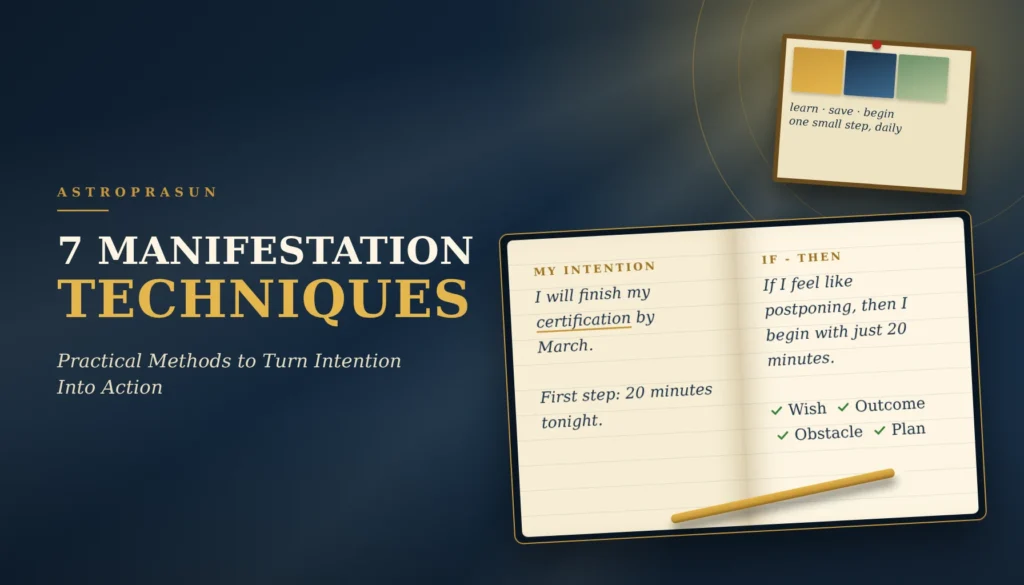
7 Manifestation Techniques That Actually Work
✦ Manifestation · Practical Methods · Self-Growth 7 Manifestation Techniques That Actually Work: A Practical…

How to Manifest Anything You Want: 7 Practical Steps
✦ Manifestation · Practical Spirituality · Self-Growth How to Manifest Anything You Want: 7 Practical…

How Manifestation Works: Science & Upanishads
✦ Spirituality · Vedic Wisdom · Self-Discovery How Manifestation Works: What Science and the Upanishads…

Seeing Snakes in Dreams Meaning
✦ Dreams · Hindu Symbolism · Vedic Astrology Seeing Snakes in Dreams Meaning: Hindu Tradition,…

Auspicious Muhurtha: Select the Right Time | AstroPrasun
✦ Jyotish · Muhurtha · Vedic Electional Astrology Auspicious Muhurtha: How to Select the Right…

Toxic Mobile Number Combinations to Avoid
✦ Numerology · Mobile Number · Caution & Remedies Toxic Mobile Number Combinations You Should…