
Seeing Snakes in Dreams Meaning: Hindu Tradition, Vedic Astrology and Spiritual Interpretation
In Hindu thought the serpent guards both fear and wisdom — your dream asks which one you are standing in front of.
⚡ Quick Summary
- A snake dream is a symbol for reflection, never a guaranteed prediction.
- Common themes: transformation, fear, healing, hidden worry and renewal.
- Hindu imagery honours serpents through Shiva, Vishnu and Nag Devta.
- One dream cannot prove Rahu-Ketu affliction, Kaal Sarp Dosha or Kundalini awakening.
- Your emotion inside the dream usually matters more than the snake’s colour.
- Write it down, reflect calmly, and avoid fear-based or costly remedies.
The results arrive in a flood. One page promises sudden wealth. Another warns of hidden enemies. A third mentions doshas and an expensive puja. You close the phone more unsettled than before.
Here is the thing. A snake dream is among the most common dreams people carry to an astrologer, and in consultations I often see people hold it quietly for weeks before mentioning it. The dream is rarely the problem. The fear that follows it is. So let us read the symbol properly — slowly, without drama, and without a sales pitch.
What follows is a calm guide to snake dream meaning in Hindu tradition and Vedic astrology: what the serpent has symbolised, 15 common dream scenarios, what Rahu and Ketu can and cannot tell you, and a five-step way to read your own dream.
Seeing Snakes in Dreams Meaning: What Does a Snake Symbolise?
Seeing a snake in a dream is usually read as a symbol of change, fear, healing or a concern you are avoiding. In Hindu tradition the serpent also carries sacred meaning through Shiva, Vishnu and Nag Devta. A snake dream is not a reliable prediction — its meaning depends on your emotions and life context.
Across cultures, the snake wears two faces at once. It is feared for its bite. It is also honoured for its stillness, its patience and its ability to shed an old skin and begin again. That double nature explains why one dream can feel threatening and strangely meaningful at the same time.
Indian thought stretches the symbol further. The serpent coils around Shiva’s neck, holds up Vishnu’s resting place and receives milk on Nag Panchami. Few animals carry that much weight. So when a snake enters your sleep, your mind may be reaching for an image your culture has loaded with meaning for thousands of years.
Swapna (SWAHP-nah, स्वप्न) is the Sanskrit word for dream. The Mandukya Upanishad names three states of consciousness — jagrat (waking), swapna (dreaming) and sushupti (deep sleep). Sarpa (SAR-pa) means serpent, and Naga (NAH-gah) refers to the serpent beings honoured across Hindu, Buddhist and Jain traditions. Together these words show how Indian thought has long treated the snake as a symbol with layers, not simply an animal.
Modern readers usually meet five recurring themes:
- Transformation — a phase of life is changing shape.
- Fear or avoidance — something difficult feels too close to face.
- Wisdom and healing — the serpent as keeper of awareness.
- Hidden concerns — worries you have not yet named aloud.
- Renewal — the shed skin and the quiet fresh start.
Notice what the list leaves out. Death. Curses. Guaranteed loss. None of them belong to a fair reading. So when someone asks about snake in dream meaning, the honest first answer is simple: it depends on you. Dream meaning is personal, and the same cobra can mean different things to two different sleepers.
Here is an analogy I like. A snake dream is a note slipped under your door in a language you half remember. The handwriting is yours. Only the meaning needs work.
The snake does not arrive in your dream to frighten you. It arrives to ask what you have been avoiding looking at. — Prosun Dey · AstroPrasun
Why Snake Dreams Matter — Is Seeing a Snake in a Dream Good or Bad?
Seeing snakes in dreams meaning matters because the fear arrives before the explanation. People search for one reason: they want to know whether to worry. Understanding the symbol lifts that one burden, and that alone is worth the reading.
So, is seeing a snake in a dream good or bad? Neither, by itself. The dream is not reliable evidence that something fortunate or unfortunate will happen. It works more like a mirror. Your emotion inside the dream, the snake’s behaviour and your current circumstances all help you reflect.
Here is a view that cuts against most search results. The popular idea that snake dreams are either lucky omens of wealth or warnings of enemies is the weakest part of the whole genre. Neither claim can be tested. And honestly? Both keep people checking their phones instead of checking their lives.
Reactions differ by place. In Kolkata, a snake may feel sacred, tied to Manasa Devi. In Sydney or Toronto, it may feel like a plain nightmare. Many Indian families I speak with in Dubai carry the old beliefs quietly while living far from home. (If you grew up between two cultures, you may feel both reactions at once — that is normal.) All of these responses are valid. None is a forecast.
Some psychological traditions also treat the snake as a symbol of fear, instinct and change. People from very different worlds have reached for the same image. You do not need to accept any one theory. Notice only that the snake keeps asking about change.
If you are reading from the US, Canada or the UK, note the difference. Western astrology uses the tropical zodiac and often reads symbols psychologically. Vedic astrology (Jyotish) uses the sidereal zodiac and centres on the Moon, the Nakshatras (lunar mansions) and planetary periods called Dashas. Neither system treats a single dream as proof of anything. In Jyotish, a dream symbol is read alongside the birth chart, never instead of it.
15 Common Snake Dream Scenarios and Their Possible Meanings
Seeing snakes in dreams meaning shifts with the scenario. Use this table as a set of reflection prompts. Find the row closest to your dream, ask the question quietly, and do not force a meaning onto it.
| Dream scenario | Possible symbolic reading | Theme |
|---|---|---|
| A snake bites you | A fear, conflict or emotionally difficult issue may need attention. Ask: what feels sharp or unresolved right now? | Caution |
| A snake chases you | You may feel you are avoiding a concern or responsibility. Ask: what have I been postponing? | Caution |
| A snake enters your house | A personal or family matter may be occupying your thoughts. Ask: what is unsettled at home? | Neutral |
| A black snake appears | Reflect on uncertainty, fear or something not yet understood. Ask: what feels unclear? | Neutral |
| A white snake appears | Some traditions link white with purity or spiritual symbolism; personal context matters. Ask: did it feel peaceful? | Powerful |
| A green snake appears | It may prompt reflection on growth, renewal or change. Ask: what is quietly growing? | Growth |
| A yellow snake appears | Consider themes of caution, awareness or personal confidence. Ask: where do I need to look more closely? | Neutral |
| A red snake appears | It may bring attention to strong emotions, urgency or conflict. Ask: what feels heated? | Caution |
| Two snakes together | Reflect on duality, relationships, tension or competing choices. Ask: which two things pull at me? | Neutral |
| Snakes fighting | The dream may mirror an inner conflict or disagreement. Ask: where am I divided? | Caution |
| A dead snake | It may symbolise the ending of a fear, phase or difficult situation. Ask: what has recently ended? | Growth |
| You kill a snake | Consider whether you are trying to confront or control a problem. Ask: am I facing it or fighting it? | Powerful |
| A snake sheds its skin | A symbol of renewal, transition or letting go. Ask: what am I ready to leave behind? | Growth |
| A snake in water | Reflect on emotional circumstances and how you are processing them. Ask: what am I feeling but not saying? | Neutral |
| A snake in your bed | Consider personal boundaries, vulnerability or relationship concerns. Ask: where do I need clearer boundaries? | Caution |
In consultations, people almost always mention the colour first. Rarely the feeling. That order is backwards.
Treat the colour rows as soft prompts. Colour symbolism varies between families, regions and teachers, and no widely accepted scripture fixes it. The snake’s behaviour and your own emotion tell you far more than its shade.
Snake Dream Meaning in Hinduism: Tradition, Symbol and Spiritual Thought
Before reading a dream through Hindu symbolism, separate three layers. First, established religious imagery. Second, modern spiritual interpretation. Third, personal psychology. Mixing the three is how confusion — and fear — begins.
Classical Indian literature does record dream omens. The Atharvaveda contains early dream references, and later Swapna Shastra texts catalogue dream signs. But those catalogues disagree with one another, which is a good reason to hold any single reading lightly.
Lord Shiva and Vasuki
Shiva is traditionally shown with the serpent Vasuki coiled around his neck. In the Samudra Manthan — the churning of the cosmic ocean — Vasuki served as the churning rope. The image suggests power held calmly: a force worn as an ornament instead of feared. It speaks of mastery. It does not promise that a dream is divine communication.
If Shiva imagery brings you peace, spend five quiet minutes with the mantra Om Namah Shivaya (ohm nah-MAH shee-VAH-yah) or a simple prayer. Treat it as comfort, not as proof that your dream was a message from the deity.
Nag Devta and the Naga Tradition
Naga worship is among the oldest living traditions in India. Nag Panchami falls in the month of Shravan, usually between July and August, when families offer milk and prayers to serpent images. In Bengal, devotees honour Manasa Devi, the serpent goddess, through village festivals. The Mahabharata tells of Janamejaya’s serpent sacrifice, halted by the sage Astika — a story families still recall on Nag Panchami. Practices differ widely by region and household.
Honouring Naga Devta is devotion, not a protection scheme. A family custom can be beautiful without turning a dream into a danger. Follow only the rituals that bring you peace.
Sheshnag and Cosmic Symbolism
Sheshnag, the many-hooded serpent, forms the couch on which Lord Vishnu rests. Here the serpent is not a threat. It is foundation, patience and the quiet support beneath creation. When someone dreams of a coiled, calm snake, this older image sometimes comes to mind.
Sheshnag in Vishnu’s story offers a lens for reflecting on patience and support. It is not evidence that Vishnu is sending you a sign.
Kundalini Symbolism
Yoga and Tantra traditions describe Kundalini (koon-dah-LEE-nee) as a coiled spiritual energy resting at the base of the spine. That is a teaching about disciplined practice. It is not a diagnosis of ordinary dreams.
A snake dream is not proof of Kundalini awakening. Experiences described in tradition usually arise through sustained practice and guidance, not through a single night’s dream.
Rahu and Ketu: What Can and Cannot Be Said
In Vedic astrology, Rahu and Ketu are the shadow planets — the severed head and body of the demon Svarbhanu in the Samudra Manthan story. They are often drawn with serpent bodies, which is why modern articles link snake dreams to them. Here is my contrarian view: that link is far weaker than the internet suggests.
A dream alone cannot establish Rahu-Ketu affliction, Kaal Sarp Dosha or any other astrological condition. That judgement needs a full birth chart, house placements and planetary periods. Kaal Sarp Dosha in its popular form is also debated among practitioners, since it does not appear in the major classical texts, such as the Brihat Parasara Hora Shastra, the way modern lists describe it.
One chart detail does connect to serpents: Ashlesha Nakshatra, whose presiding deity is Sarpa, the serpent. If your Moon sits there, the serpent theme may feel familiar. Even so, it does not turn a dream into a diagnosis. You can check your Moon’s position with the Lucky Nakshatra Calculator and view your chart with the Vedic Kundali tool.
A remedy quoted at ₹25,000 (about $300) after a single dream deserves a long pause. A responsible astrologer reads the chart first and never guarantees an outcome from a dream.
How the Strength and Tone of Your Dream Change the Reading
Not every snake dream carries the same weight. Two things shift the reading most: how strong the dream felt and what tone it carried. By strong, I mean vivid, remembered in detail or repeated. By weak, I mean a faint fragment you almost forgot. Tone is simply whether the snake and your feelings were calm or threatening.
Strong + Positive · Vivid, calm snake
You remember every detail and felt steady or curious. This often reads as awareness, healing or a transition you are already handling well. Note what was happening in your life when it appeared.
Weak + Positive · Faint, gentle snake
A soft fragment with no fear attached. Usually a light prompt — a small change or quiet curiosity at the edge of your attention. Noticing is enough.
Strong + Threatening · Vivid, frightening snake
A clear chase or bite with real fright often points to an avoided concern. Ask what feels too big to face, then take one small step toward it. Fear in the dream is not a forecast.
Weak + Threatening · Faint, uneasy snake
A vague unease you cannot place. Often tied to tiredness or stress. Look at sleep and routine before looking at the stars.
If disturbing dreams are frequent and significantly affect your sleep, mood or daily life, speak with a doctor or a qualified mental health professional. A symbol can be read with care. A sleep problem deserves proper support.
Why Do Snake Dreams Keep Repeating?
Recurring snake dreams usually have everyday explanations. Stress and anxiety come first. A recurring unresolved concern can return night after night. Major transitions — a new job, a move abroad, a marriage — often stir the same symbol.
Recent exposure matters too. A documentary, a news clip or a family story about snakes can surface in sleep. In India, the monsoon from June to September brings real sightings and warnings from neighbours, and that exposure can follow you to bed. Strong emotions also stay active at night.
None of this needs a supernatural cause. I would not imply one, and I would not diagnose you from a distance. Recurring snake dreams meaning is usually found in your calendar before it is found in your chart.
How to Understand Your Own Snake Dream: A Five-Part Reflection
You do not need a dictionary of symbols. You need five honest questions. Ask them in the morning, with a cup of chai and a notebook.
- Notice the snake. What did it look like? Was it calm, aggressive, still or moving?
- Recall the setting. Was it at home, outdoors, in water or somewhere unfamiliar?
- Name your emotion. Were you frightened, calm, curious, helpless or confident?
- Check your current life. Is a change, conflict or decision occupying your mind?
- Look for patterns. Has it repeated, and what was happening around that time?
Write the dream down soon after waking, before it fades. Record the feeling, not just the picture. Over three or four weeks, patterns tend to appear on their own. That is far more reliable than forcing a meaning onto a single night.
What Should You Do After Seeing a Snake in a Dream?
Whatever the seeing snakes in dreams meaning turns out to be for you, keep your response calm and practical.
- Write down the dream and how it felt.
- Reflect on current worries or changes.
- Use prayer, meditation or a familiar spiritual practice if it brings peace.
- Follow family or community traditions only if they are meaningful to you.
- Avoid expensive, fear-based remedies or anyone guaranteeing an outcome.
- Seek professional support if disturbing dreams affect sleep or daily life.
Before sleep, take five slow breaths and set a gentle intention: “I will look at what comes, calmly.” Keep a notebook beside your bed. Many people find the fear softens once the dream is written down.
A Balanced Spiritual Perspective
Spiritual symbolism gives you a useful lens for reflection. It does not give you a forecast. A dream is not a diagnosis of planetary affliction, and it is not a verdict on your future.
If you see astrology as a tool for self-discovery, treat the dream as information about your inner weather. A dream journal costs nothing. It often tells you more about what is troubling you right now than any chart reading could.
In Vedic astrology, the birth chart is the foundation. A dream can prompt a question, but only the chart, read with your current Mahadasha and Antardasha, can say whether a larger pattern is at work. That is why I always read the chart first and the dream second.
If a bigger question sits behind your dream — about timing, relationships or direction — a personal reading can help. It is optional, never necessary to “prevent” anything. Consultations are available online for readers in India, the UAE, UK, US, Canada and Australia.
Frequently Asked Questions — Snake Dream Meaning
What does seeing a snake in a dream mean in Hinduism?
In Hindu tradition the snake is a layered symbol rather than a single omen. It appears as Vasuki around Lord Shiva’s neck, as Sheshnag beneath Lord Vishnu, and in Naga worship across India. A snake dream may therefore invite reflection on power, protection, fear or transformation. No scripture fixes one meaning for every snake dream, and interpretations vary by region and family tradition. Treat the dream as a prompt for reflection, not as a prediction or a message that demands a costly remedy.
Is seeing a snake in a dream good or bad?
Neither, by itself. A snake dream is not reliable evidence that something fortunate or unfortunate will happen. Its value lies in reflection. Notice how you felt, how the snake behaved and what is changing in your life. Calm or curious dreams often relate to awareness or renewal, while frightening ones may point to a concern you have been avoiding. Context and emotion decide the meaning, not the snake alone.
What does a black snake in a dream mean?
A black snake in a dream is usually read as a symbol of uncertainty, fear or something not yet understood. Black is also the colour of depth and the unknown, so some people link it with hidden emotions or a decision still in shadow. Colour symbolism varies between families and teachers, and no scripture fixes it. Ask what feels unclear in your life right now, and notice whether you felt afraid, calm or curious.
What does a white snake in a dream mean?
Some traditions associate white with purity, calm and spiritual symbolism, so a white snake may prompt reflection on peace, clarity or a quiet inner shift. Others read it simply as a rare, striking image your mind produced. Colour meanings differ by region and family, and none is fixed by scripture. Personal context matters most: consider whether the snake felt peaceful or threatening, and what was changing in your life around that time.
What does it mean when a snake bites you in a dream?
A snake bite in a dream is often read as a symbol of a fear, conflict or emotionally painful issue that needs attention. It does not predict harm or illness. Ask yourself what feels sharp or unresolved right now, such as a tense conversation or a delayed decision. If the dream repeats and disturbs your sleep, consider speaking with a doctor or counsellor for support.
What does it mean when a snake chases you in a dream?
A snake chasing you in a dream is often read as a sign that you are avoiding a concern, responsibility or difficult conversation. The pursuit mirrors how persistent the worry feels, even when you try to outrun it. It does not predict danger. Ask what you have been postponing lately, and consider one small step toward it. If chase dreams repeat and disturb your sleep, a doctor or counsellor can help.
What does it mean to see two snakes in a dream?
Two snakes in a dream are often read as a symbol of duality — two relationships, two choices or two sides of yourself pulling in different directions. Some traditions associate paired serpents with the balance of opposing energies. Neither reading predicts an event. Ask what two things currently compete for your attention, and whether the snakes seemed calm or in conflict, since that tone changes how you reflect on the dream.
What does a dead snake in a dream mean?
A dead snake in a dream is often read as the ending of a fear, a phase or a difficult situation. It may reflect relief, closure or something you have finally put down. Because snakes also symbolise renewal, some people see it as a pause before change. It is not a prediction. Ask what has recently ended in your life, and how you felt when you saw the snake lying still.
What does it mean when a snake enters your house in a dream?
A snake entering your house in a dream is often read as a personal or family matter occupying your thoughts. The home stands for your private world, so the image may point to something unsettled there — a worry, a tension or a decision. It is not a forecast of loss or danger. (A real snake inside a home is a safety matter, so call local wildlife rescue.)
Does seeing a snake in a dream mean Rahu or Ketu is affecting me?
No. Rahu and Ketu are linked with serpent imagery in Vedic astrology, but a single dream cannot establish Rahu-Ketu affliction or Kaal Sarp Dosha. Those judgements require a full birth chart, house placements, planetary periods and careful analysis by a qualified astrologer. Be cautious of anyone who diagnoses a dosha from one dream alone or pressures you toward costly remedies.
Why do I keep seeing snakes in my dreams?
Recurring snake dreams usually have everyday causes. Stress, anxiety, an unresolved concern or a major life transition can all bring the same symbol back. Recent exposure to snake stories, images or even monsoon-season sightings may also play a part. Keep a dream journal, note your emotions and look for patterns. If the dreams affect your sleep or daily life, speak with a doctor or qualified professional.
Final Thoughts — Read the Dream, Not the Fear
Seeing snakes in dreams meaning is not fixed by any dictionary. It depends on your emotion, your circumstances and your beliefs. The serpent has been honoured in India for thousands of years as a symbol of power, patience and renewal. Your dream may simply be borrowing that image to ask a question.
So write it down. Reflect on it. Let prayer or quiet practice steady you if that is your path. And walk away from anyone who sells fear. To explore the Moon placement that shapes your own inner life, try the Lucky Nakshatra Calculator or the Nakshatra Pada Calculator. More guides like this live on the AstroPrasun blog. For a calm, personal reading from Prosun Dey at AstroPrasun, you can book a consultation.
This guide is written for cultural and reflective purposes. Dream interpretations are symbolic, vary by tradition and are not predictions. Nothing here is medical, psychological or financial advice. If dreams or worries are affecting your health or daily life, please speak with a qualified professional.
Want to Look Deeper Than One Dream?
A dream can raise a question, but your answer lives in your birth chart, your current planetary period and your life as it is now. If a snake dream has stirred a bigger question about timing, relationships or direction, a calm personal reading with Prosun Dey at AstroPrasun can help — with no fear, no pressure and no guaranteed outcomes.
🌐 astroprasun.com · 📧 contact@astroprasun.com
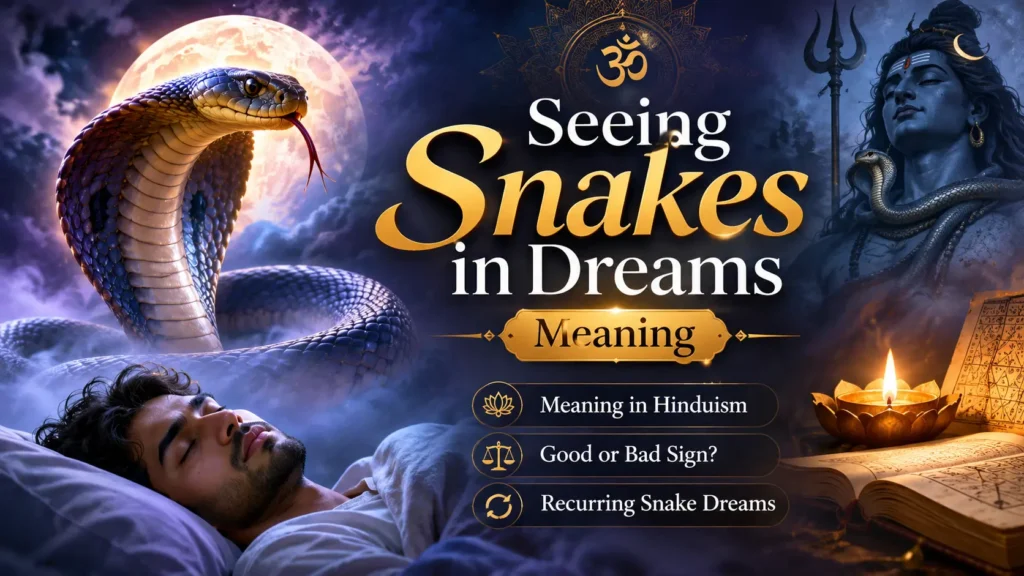
Seeing Snakes in Dreams Meaning
✦ Dreams · Hindu Symbolism · Vedic Astrology Seeing Snakes in Dreams Meaning: Hindu Tradition,…

Auspicious Muhurtha: Select the Right Time | AstroPrasun
✦ Jyotish · Muhurtha · Vedic Electional Astrology Auspicious Muhurtha: How to Select the Right…

Toxic Mobile Number Combinations to Avoid
✦ Numerology · Mobile Number · Caution & Remedies Toxic Mobile Number Combinations You Should…

Lucky Mobile Number by Date of Birth | AstroPrasun
✦ Numerology · Mobile Number · Date of Birth Compatibility Lucky Mobile Number According to…

Is My Mobile Number Lucky? Check It | AstroPrasun
✦ Numerology · Mobile Number · Chaldean System Is My Mobile Number Lucky? How to…

Numerology Remedies for Missing Numbers in Lo Shu Grid | AstroPrasun
✦ Numerology · Lo Shu Grid · Remedies Numerology Remedies for Missing Numbers in Lo…