
Binaural Beats and Mozart Effect: What Science Really Says About Sound and the Brain
Sound can change how you feel and work — but a frequency is not a switch, and Mozart is not a shortcut to genius.
⚡ Quick Summary
- Binaural beats are a real perceptual illusion; reliable brain-wide entrainment remains unproven.
- Evidence for better focus, memory or intelligence from binaural beats is mixed at best.
- The 1993 Mozart Effect was a brief spatial-task result, not an IQ boost.
- Mood, alertness and personal taste explain much of music’s effect on performance.
- Structured music interventions show promise; passive playlists are a different thing.
- Test sound on your own tasks, keep volume safe, and never replace medical care.
It is 11:40 pm in a Kolkata flat. A Class 12 student sits with earbuds in and a physics chapter open. On screen, a video promises “genius-level memory in twenty minutes” through 40 Hz gamma waves. The comments are glowing. Down the hall, his mother wonders whether the Mozart she once played for him as a baby did anything at all.
Same house. Same hope. Two different claims about sound and the brain.
Here is the thing — both claims share a root, and both are partly true and mostly stretched. This guide examines what research on binaural beats and Mozart effect studies actually found, where the hype began, and how you can test sound on your own mind without wasting money or trust.
Do binaural beats or Mozart make you smarter? Not in any lasting, reliable way. Binaural beats can be perceived, and some experiments find measurable neural responses. Dependable gains in intelligence, memory or focus are not established. The Mozart Effect was a temporary result on one spatial task. Music can still shift mood and alertness — and that matters more than the myth.
How Sound Affects the Brain: From Nada to Neurons
Indian thought has taken sound seriously for a very long time. The Sanskrit word nāda (NAH-dah) means sound or vibration, and classical music theory treats it as the root from which melody grows. The 13th-century treatise Sangita Ratnakara by Sarngadeva opens its discussion of music with exactly this idea.
Nāda is the Sanskrit term for sound as ordered vibration. In Indian philosophy it is more than noise: it is sound with the potential to carry meaning, emotion and attention. Neuroscience does not test the spiritual claims around nāda. It asks a narrower question — what happens in the nervous system when sound arrives?
Here is what happens. Sound waves enter the ear canal and move the eardrum. Tiny bones pass that vibration to the cochlea, a fluid-filled spiral in the inner ear. Hair cells inside the cochlea convert vibration into electrical signals, and the auditory nerve carries those signals through the brainstem and thalamus to the auditory cortex.
That is the easy part. The interesting part comes next.
Once the signal arrives, the brain does far more than label a pitch. It tracks rhythm, predicts what comes next, compares the sound with memory, and attaches feeling to it. Depending on the music, the listener and the task, many systems take part:
- Auditory cortex — pitch, timbre and pattern.
- Prefrontal networks — attention, planning and evaluation.
- Hippocampus — memory and familiarity.
- Amygdala — emotional meaning.
- Nucleus accumbens — reward and pleasure.
- Cerebellum and motor networks — timing, prediction and the urge to move.
Think of the dhak drums at Durga Puja in Kolkata. Within seconds of the first roll, shoulders loosen, hearts speed up and strangers smile. No one needs a laboratory to feel it. But notice what that experience involves: memory, culture, crowd, reward and rhythm — all at once. That is why no single track “activates one brain region” and why one frequency rarely produces one predictable feeling.
Sound does not press a single button in the brain. It plays the whole instrument. — Prosun Dey · AstroPrasun
Why Binaural Beats and Mozart Effect Claims Deserve a Closer Look
Walk through any exam season — Kota, Delhi, Kolkata — and you will find students hunting for an edge. Walk through a Toronto or Dubai open-plan office and you will find professionals in noise-cancelling headphones doing the same. Playlists labelled “alpha waves,” “432 Hz” or “genius frequency” promise to rewire everything.
In my years of working with clients, I have noticed that people rarely fall for these claims out of foolishness. They fall for them out of hope. They are tired, stretched and looking for something simple. And honestly? A free video that promises focus sounds far easier than a better sleep routine.
So what problem does this article solve? It gives you a way to sort claims by strength. Instead of asking “does this work?”, you learn to ask which kind of evidence supports it. Those are very different questions (and the second one saves money).
- Perception: you can hear the effect. Established for binaural beats.
- Neural response: instruments detect some brain activity change. Reported in some experiments.
- Reliable entrainment: broad brain regions lock to the beat. Not established.
- Real-world benefit: better focus, memory or sleep in daily life. Needs its own evidence.
Most marketing jumps from level one straight to level four. Good science climbs the ladder one rung at a time. Keep this ladder in mind, because every study below sits on a particular rung.
For readers in Australia and the wider wellness community, there is a gentler way to hold this. Sound is a legitimate tool for mood and self-awareness. It simply does not need exaggerated promises to be worth using.
Binaural Beats and Mozart Effect: Claims vs Evidence
Before the detail, here is the whole map in one table. Read the status badge first, then the note beside it.
| Claim | Evidence Status | What It Means for You |
|---|---|---|
| Binaural beats can be perceived | Established | Slightly different tones in each ear can produce a perceived beat at the difference frequency. |
| Binaural beats produce measurable neural responses | Some experiments | Findings vary across studies. A response is not the same as a benefit. |
| Binaural beats synchronize the whole brain | Not established | Reliable, broad entrainment has not been shown consistently. |
| Binaural beats raise intelligence | Not established | No robust evidence supports this claim. |
| Music influences emotional experience | Well supported | Mood shifts are real, though responses differ from person to person. |
| Music affects cognition in some situations | Context-dependent | Depends on the listener, the task, and whether the music competes for attention. |
| Mozart uniquely increases IQ | Not established | The original finding was a temporary result on one spatial task. |
| Structured music interventions help selected outcomes | Promising | Encouraging, with limitations. Do not generalise to every passive playlist. |
Notice the pattern. The strongest claims sit on the experience of sound itself — hearing, feeling, mood. The weakest sit on grand promises about intelligence and brain rewiring. That gap is the whole story of this field.
What the Research Actually Shows
What Are Binaural Beats, and Do They Change Brainwaves?
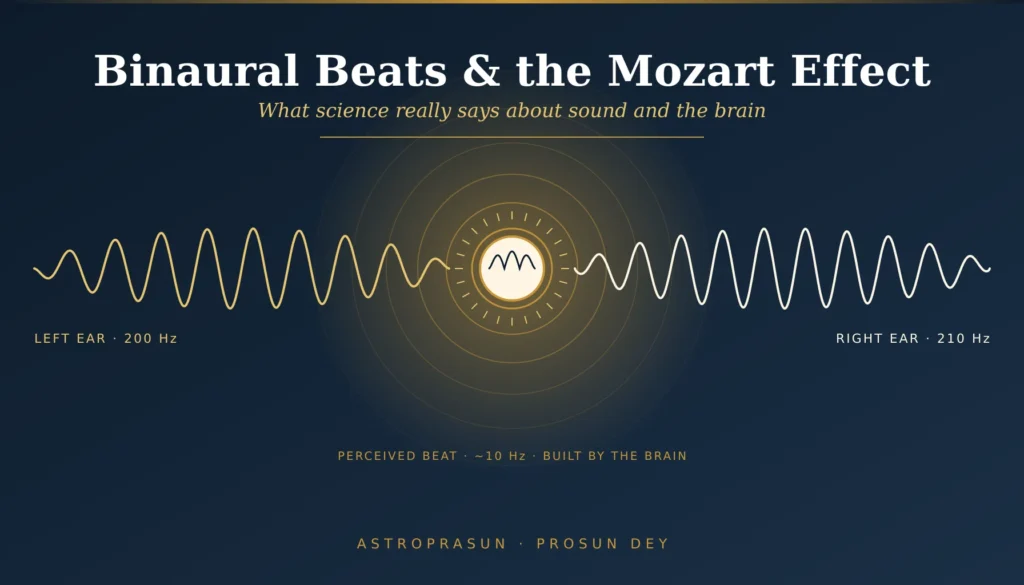
Binaural beats arise when two slightly different pure tones reach your two ears separately, usually through stereo headphones. Play 200 Hz in the left ear and 210 Hz in the right, and you may perceive a pulsing at about 10 Hz — the difference between them. Nothing in the room pulses at 10 Hz. Your brain builds the beat itself.
Picture two tanpura strings tuned a hair apart. In a room, you hear the shimmer in the air. Now put each string in a separate room and give you one earpiece for each. The shimmer still appears — because your brain is doing the subtraction. That is a binaural beat.
The excitement comes from brainwave bands, which EEG machines measure. The ranges below are approximate, and the boundaries differ between research conventions.
| Band | Approx. Frequency | Common Associations |
|---|---|---|
| Delta | 0.5–4 Hz | Deep NREM sleep and slow-wave activity |
| Theta | 4–8 Hz | Drowsiness, memory processes, some learning-related activity |
| Alpha | 8–12 Hz | Relaxed wakefulness, aspects of attention and inhibition |
| Beta | 13–30 Hz | Alertness, active thinking, task engagement |
| Gamma | 30–100 Hz | Higher-frequency processing and coordinated activity |
These bands describe patterns recorded from the brain. They are not mental-state buttons. Playing a sound that matches “alpha” does not prove you will feel alpha-like calm. Correlation in a lab recording is not a recipe for a mood.
So do binaural beats entrain the brain? A 2023 systematic review in PLOS ONE looked at 14 studies. Five supported entrainment, eight did not, and one reported mixed results. Methods varied widely. A 2020 eNeuro study found some cortical responses and cross-frequency connectivity linked to binaural beats. Yet monaural beats — where the tones are mixed before reaching the ears — produced stronger cortical entrainment, and the claimed mood effect was not demonstrated.
The honest reading: some measurable responses may occur. Whole-brain synchronization on demand has not been shown.
Do Binaural Beats Improve Focus, Memory or Intelligence?
Sellers usually map each band to a promise: delta for sleep, theta for meditation and creativity, alpha for relaxation, beta for alertness, gamma for memory and “high performance.” Each promise borrows a real association from EEG research and turns it into a product claim.
Test that against data. One study of a 40 Hz gamma binaural-beat condition found no significant improvement in attention or anxiety in its setting. A 2024 systematic review of music, noise and binaural beats in relation to autonomic arousal and cognition found mixed or insufficient evidence for any simple link between auditory stimulation, arousal and performance.
No robust evidence shows that any binaural-beat frequency increases intelligence or reliably boosts memory. A neural response in a lab does not automatically become a better exam score. Be wary of paid tracks promising IQ gains, “subconscious reprogramming” or miracle focus — whether the label says 432 Hz, 528 Hz or gamma.
Binaural Beats for Stress and Sleep: Promising, Not Proven
Relaxation is where binaural beats look most interesting. A 2024 systematic review of randomized controlled trials on stress management found promising results in some studies but inconsistent results overall. The authors flagged methodological concerns, uncertainty about the best listening protocol and limited knowledge of adverse effects.
Why might relaxing audio help at all? Partly because any calming sound, paired with a quiet routine and a pair of headphones, tells your body that the day is winding down. That signal may owe as much to expectation and context as to the beat frequency. Individual response varies. Some people feel calmer. Others feel nothing, or feel irritated by the hum.
If you are curious, treat binaural beats as a low-stakes relaxation experiment, not a treatment. Use comfortable volume, stereo headphones and a few minutes in a quiet place. Compare the experience with plain silence or soft instrumental music. Anxiety disorders and insomnia need proper clinical care — audio is at most a companion to it.
What Was the Original Mozart Effect — and Does Mozart Make You Smarter?
The phrase comes from a 1993 study by Rauscher, Shaw and Ky, published in Nature. Participants listened to Mozart’s Sonata for Two Pianos in D Major, K. 448 and then did a spatial-reasoning task. They performed better on that task for a short window afterwards.
Read that again. A short window. One task. Spatial reasoning.
Nothing in the original result showed a lasting rise in IQ, and nothing showed that babies become cleverer. Popular media stretched a narrow finding into a parenting product. Later research tells a more modest story. A 2010 meta-analysis covering nearly 40 studies and over 3,000 participants found a small effect (d = 0.37) on spatial tasks when music was compared with silence or non-musical stimuli. That is no evidence of a Mozart-only intelligence boost.
IQ is a broad measure built across many abilities. A temporary bump on one short spatial task does not change it. A 2023 meta-analysis on Mozart music and epilepsy-related outcomes found non-significant, trivial-to-small effects and warned against assuming any Mozart-specific effect. Mozart music is not a treatment for epilepsy or any other medical condition.
Why Music Still Helps: Mood, Arousal and Personal Taste
If Mozart is not magic, why did the effect appear at all? The leading explanation is the arousal-and-mood hypothesis. Music you enjoy lifts mood and alertness, and a more alert, more positive person may do a short task slightly better. A calming track may help someone settle before study. Music they dislike, or music that competes with the task, can make performance worse.
This explanation does not need Mozart. It needs a listener, a task and a reaction.
Here is the contrarian part, and it is the insight I would most like you to keep. The best study music is not the most prestigious music. It is the music that suits your task and your nervous system. For one person that is K. 448. For another it is a slow instrumental film score, soft ambient sound or a favourite instrumental raga recording. And for deep, demanding work, silence is a perfectly respectable tool.
Instrumental pieces tend to suit reading and writing because they compete less with the words in your head. Tempo, complexity, familiarity and predictability all matter. Lyrics in a language you understand can pull attention away from verbal tasks. Classical music is therefore often a helpful environment — not a direct cognitive enhancer — and it is not always superior.
Routine or repetitive tasks — sorting files, cleaning, light revision — often tolerate music you enjoy. Demanding reading, writing or problem-solving usually works better with quiet or calm instrumental sound. Test, observe, and keep what works for you.
Sound, Psychology and Performance: What Modifies the Effect
Broader research gives a wider frame. A 2022 Nature Reviews Neuroscience review, “Music in the Brain,” describes how music engages perception, emotion, pleasure and learning. A 2026 systematic review and meta-analysis of 32 studies — 16 on music listening and 16 on music-based interventions — reported small-to-moderate gains in some emotional outcomes and small positive effects on cognition, memory and executive function. Attention findings were less consistent, and the authors noted risk of bias and limits to generalisability.
One distinction deserves emphasis. Structured, designed music interventions are not the same as passively playing a Mozart track or a binaural-beat video. Do not borrow the results of one to defend the other.
Sound shapes psychology through several routes at once. It triggers memories through association. It signals safety or threat. It drives movement through rhythm. And background noise adds cognitive load, which is why a noisy open-plan office tires people out. Culture and personal history colour every response. A lullaby from your grandmother carries meaning no frequency chart can capture.
Across five dimensions of mental performance, the role of sound looks like this:
- Attention and concentration: sound can support or interrupt sustained focus.
- Memory and learning: emotion and association may influence encoding and recall.
- Emotional regulation: music can shift mood and subjective stress.
- Executive function: task difficulty, distraction and arousal affect planning and control.
- Sleep and recovery: a calm sound environment may aid relaxation, without guaranteeing better sleep.
The four scenarios below show how the same tools can behave very differently, depending on fit.
Strong + Positive
Music you enjoy, matched to the right task, in a quiet setting. Mood lifts, focus steadies and the work flows. This is the realistic best case.
Weak + Positive
Soft ambient or binaural-labelled audio during a routine task. You feel slightly calmer. The benefit is small and may owe much to expectation and routine.
Strong + Negative
Lyrical or intense music while reading dense material. The sound competes with the words, and accuracy and comprehension drop.
Weak + Negative
Paid “genius” tracks that deliver nothing — except disappointment, lost money and a habit of blaming yourself instead of the claim.
Keep volume comfortable. Stop if audio causes headache, dizziness or distress. Never use attention-absorbing audio while driving or operating machinery. Evidence on adverse effects and ideal protocols for binaural beats is limited. Do not use any audio as a substitute for medical or psychological treatment, and speak to a qualified clinician about health concerns.
How to Use Sound Wisely: A Seven-Day Personal Experiment
Instead of trusting any claim — including mine — test sound on your own work. This is an informal self-observation exercise, not a clinical trial. Pick one task you do regularly, such as study, writing or a work report, and keep it the same all week.
| Day | Listening Condition | What to Observe |
|---|---|---|
| 1 | Silence or your usual environment | Baseline focus and task completion |
| 2 | Mozart, K. 448 | Focus, mood and distraction |
| 3 | Other instrumental classical music | Compare with Day 2 |
| 4 | Ambient instrumental music | Relaxation and task engagement |
| 5 | Alpha-labelled binaural beat audio | Subjective response — do not assume entrainment |
| 6 | Beta-labelled binaural beat audio | Focus, fatigue and comfort |
| 7 | Your personally preferred music | Overall comparison |
Track six simple measures each day: minutes spent on the task, noticeable distractions, tasks completed, accuracy or quality of work, mental fatigue, and mood before and after. Write them in a notebook. Five minutes of notes will tell you more than an hour of videos.
One warning. Sleep, time of day, task difficulty and plain expectation all shape results. A single week is a hint, not a verdict. For a fairer comparison, repeat each condition and shuffle the order. Free stereo headphones are not required, but a decent pair — often ₹1,500 to ₹3,000 or roughly $20 to $40 — helps if you test binaural beats, since the two ears must receive separate tones.
For sleep, think routine before tracks. Dim lights, consistent timing and a calm sound environment support relaxation. They do not treat insomnia, and a persistent sleep problem deserves a doctor’s attention.
What Science Knows, Suggests and Does Not Yet Know
Here is the whole field in three boxes.
Binaural beats can be perceived when different tones are presented separately to each ear. Music engages distributed auditory, emotional, memory and reward systems. Music can influence subjective emotional experience.
Binaural beats may produce measurable neural responses in some conditions. Music may support selected cognitive or emotional outcomes depending on context. Some listeners may find particular audio useful for relaxation or task routines.
That binaural beats reliably synchronize the whole brain. That a specific frequency reliably raises intelligence or memory. That Mozart uniquely makes people smarter or permanently lifts IQ. That any sound frequency treats a medical or psychological disorder.
Sound is more than entertainment. It is part of how humans feel, remember and gather themselves — in a Kolkata pandal, a Toronto commute or a quiet study room at midnight. Use it with curiosity. Observe how it changes your own day. And judge every promise about “brain power” by the evidence behind it, not the confidence of the thumbnail.
If you enjoy exploring traditional frameworks alongside science, our guide to different numerology systems explained shows how to read each system on its own terms, and our page on Vedic name numerology does the same for names. Neither validates neuroscience claims — they stand as separate traditions.
Research References
- Systematic review of binaural beats and brainwave entrainment, PLOS ONE, 2023 — PMC10198548.
- Study of cortical responses to auditory beats, eNeuro, 2020 — eNeuro 7(2).
- Systematic review of binaural beats for stress management, 2024 — doi.org/10.1080/18387357.2024.2374759.
- Study of 40 Hz gamma binaural beats, attention and anxiety — Springer.
- Meta-analysis of the Mozart Effect, Intelligence, 2010 — doi.org/10.1016/j.intell.2010.03.001.
- Meta-analysis on Mozart music and epilepsy-related outcomes, 2023 — PMC9988829.
- “Music in the Brain,” Nature Reviews Neuroscience, 2022 — nature.com.
- Systematic review of music, noise, binaural beats, arousal and cognition, 2024 — doi.org/10.1016/j.ijpsycho.2024.112328.
- Systematic review and meta-analysis of music listening and music-based interventions, 2026 — PMC13391587.
Frequently Asked Questions — Binaural Beats and Mozart Effect
What are binaural beats and how do they work?
Binaural beats are an auditory illusion. When two slightly different pure tones are played separately into each ear through stereo headphones, you may perceive a rhythmic beat equal to the difference between them. For example, 200 Hz in one ear and 210 Hz in the other can produce a perceived 10 Hz beat. The beat is created by your brain, not by a physical 10 Hz sound in the room.
Do binaural beats actually change brainwaves?
Sometimes they produce measurable neural responses, but reliable whole-brain change has not been shown. A 2023 systematic review of 14 studies found five supporting entrainment, eight not supporting it and one mixed. A 2020 study found some cortical responses, yet monaural beats produced stronger entrainment. So the honest answer is: possibly in small, measurable ways, but not dependably or powerfully.
Which binaural beat frequency is best for concentration?
No frequency has been proven best for concentration. Beta-range beats, roughly 13 to 30 Hz, are marketed for alertness, but there is insufficient evidence for a dependable boost. A study of 40 Hz gamma beats found no significant attention improvement. If you are curious, test beta-labelled audio against silence and instrumental music for a week, and keep whichever helps you finish work with the least strain.
Can binaural beats improve memory or intelligence?
There is no robust evidence that binaural beats increase intelligence, and memory benefits are not established. Some experiments report neural responses, but a response in a laboratory does not prove a better exam score or daily performance. Claims that gamma or any other frequency unlocks genius-level memory go beyond the research. Sleep, practice, structured study and good health remain far better supported routes.
What is the Mozart Effect?
The Mozart Effect refers to a 1993 study by Rauscher, Shaw and Ky. Participants who listened to Mozart’s Sonata for Two Pianos in D Major, K. 448, performed better on a spatial-reasoning task for a short time afterwards. The finding was narrow and temporary. Popular media later stretched it into the idea that Mozart makes children or adults permanently smarter, which the research does not support.
Does listening to Mozart increase IQ?
No. Listening to Mozart has not been shown to raise IQ. The original result was a temporary improvement on one spatial task, not a lasting intelligence gain. A 2010 meta-analysis of nearly 40 studies found a small effect (d = 0.37) on spatial tasks when music was compared with silence or non-musical stimuli. That points to a modest, short-term effect, not a permanent increase in intelligence.
Is Mozart better than other classical music for studying?
Evidence does not show that Mozart is uniquely better. Other music you enjoy may influence mood and alertness in similar ways. What matters is personal taste, familiarity, tempo, complexity and the task. Instrumental music tends to compete less with verbal work than lyrics do. For demanding reading or writing, quiet can be best. Try Mozart, other instrumentals and silence, then compare your own results.
Are binaural beats safe to listen to every day?
Research on long-term effects and ideal listening protocols is limited, so no firm rule exists. Keep volume comfortable, and stop if you feel headache, dizziness or distress. Never listen while driving or operating machinery. Binaural beats are not a substitute for medical or psychological treatment. If you have a health condition or concerns, check with a qualified clinician before making them a daily habit.
Curious About Your Own Patterns?
Science helps you test what sound does for your mind. If you also enjoy exploring Vedic traditions, Prosun Dey at AstroPrasun offers personal consultations — available to clients in India, the US, UK, UAE, Canada and Australia. Start with our complete guide to understanding your birth chart, or book a session directly.
Book Your Personal Consultation
Stress and Telomeres: Does Your Mind Age You?
✦ Mind-Body Wellness · Stress Science · Healthy Ageing Stress and Telomeres: Can Your Mental…
Binaural Beats and Mozart Effect: The Facts | AstroPrasun
Sound · Brain · Evidence Binaural Beats and Mozart Effect: What Science Really Says About…
Deep Focus: How to Build Discipline, Master Concentration and Enter Flow
✦ Psychology · Productivity · Self-Mastery Deep Focus: How to Build Discipline, Master Concentration and…
7 Manifestation Techniques That Actually Work
✦ Manifestation · Practical Methods · Self-Growth 7 Manifestation Techniques That Actually Work: A Practical…

How to Manifest Anything You Want: 7 Practical Steps
✦ Manifestation · Practical Spirituality · Self-Growth How to Manifest Anything You Want: 7 Practical…

How Manifestation Works: Science & Upanishads
✦ Spirituality · Vedic Wisdom · Self-Discovery How Manifestation Works: What Science and the Upanishads…