
Stress and Telomeres: Can Your Mental State Influence How Fast You Age?
Can chronic stress speed up cellular ageing — and can better recovery habits protect your long-term health?
⚡ Quick Summary
- Telomeres are protective caps on chromosomes; they shorten as cells divide.
- Research links chronic stress to shorter telomeres — an association, not proven cause.
- Telomerase helps maintain telomeres, but it is not a simple anti-ageing switch.
- No proof exists that meditation or gratitude reverses biological ageing.
- Sleep, movement, connection and slow breathing support wellbeing whatever telomeres do.
- Persistent anxiety, low mood or poor sleep deserves professional support.
Picture two people, both 45. Same birth year, same grey strands at the temples. One is a software lead in Bengaluru who has barely slept properly in three years — deadlines, a parent in hospital, a home loan. The other works a steady job in Pune, walks every evening and still phones his sister every Sunday.
On paper, they are identical. Inside, their bodies may be telling very different stories. For more than twenty years, scientists have asked whether stress and telomeres — the protective caps at the ends of our chromosomes — help explain that gap.
The honest answer is more interesting than the headlines. It is not a miracle. It is not a myth either. And it carries a message that is far kinder than the fear-based version you may have seen on social media.
What Is Biological Ageing — and Why Do Two 45-Year-Olds Differ?
Chronological age is simple arithmetic. Today’s date minus your birth date. Biological age is messier. It describes how well your tissues, organs and cells are functioning, and it does not move in lockstep with the calendar.
Why the difference? Ageing is shaped by many interacting influences — your genes, your lifestyle, your environment, your medical history and the amount of pressure your body carries over the years. No single one writes the whole story. Stress is one thread among several, not the master switch.
Biological age is a loose label for how worn or well-maintained your body’s systems are compared with your years lived. There is no single agreed measure — researchers use blood markers, organ function, and sometimes telomere length as partial clues.
Indian philosophy has an old word for the process itself: jarā (pronounced “JAH-rah”), meaning ageing or decay. Classical traditions treat it as one of life’s unavoidable facts, alongside birth, illness and death. The question was never how to escape it, but how to meet it.
Here is the thing most longevity content skips. Telomere length, taken alone, cannot tell you your health or your lifespan. It is one clue on a very long list. Keep that in mind as we go — it will protect you from a lot of hype.
Your birth certificate counts the years. Your body keeps a quieter ledger of how those years felt. — Prosun Dey · AstroPrasun
What Are Telomeres and What Is Telomerase?
To understand telomeres, begin one level down. Almost every cell in your body carries DNA, the instruction manual for building and running you. That DNA is packaged into 46 structures called chromosomes — 23 pairs, one set from each parent.
Telomeres: The Protective Caps on Your Chromosomes
A telomere is a repeating stretch of DNA, bound to protective proteins, that sits at the tip of every chromosome. The classic comparison is a plastic aglet — the little tip on a shoelace that stops it from fraying.
Here is a comparison you may not have heard. Imagine a photocopier that clips off the last line of the page every time it copies. If your page had text right to the bottom edge, you would lose words with each copy. A blank margin at the foot of the page solves it — the machine eats margin, never message. Telomeres are that blank margin. Cells divide, the margin shrinks, and the genes stay safe — for a while.
Why Do Telomeres Get Shorter?
Mostly because of ordinary biology. Every time a cell divides, the copying machinery cannot fully duplicate the very end of the DNA strand, so each division trims a little. Oxidative stress — damage from reactive molecules produced during normal metabolism — can also speed up the wear in laboratory settings. People differ widely in how fast this happens, and in the starting length they were born with.
What Happens When Telomeres Become Very Short?
When telomeres reach a critically short or damaged state, the cell usually stops dividing. This state is called cellular senescence. Think of a worn-out employee who stays on the payroll but no longer does the job. Senescent cells linger and can release inflammatory signals into surrounding tissue.
Short telomeres have been associated with several age-related conditions. But association is not prediction. You cannot look at one person’s telomere length and forecast their lifespan.
Telomerase: The Enzyme That Helps Maintain Telomeres
Telomerase is an enzyme that can add telomere repeats back onto chromosome ends. It is active in some cell types — notably stem cells and certain immune cells — and largely quiet in many others. Telomerase also appears to have direct protective functions for telomeres.
The foundational discoveries came from Elizabeth Blackburn and Carol Greider, who identified telomerase in the 1980s. Blackburn, Greider and Jack Szostak shared the 2009 Nobel Prize in Physiology or Medicine for this work.
| Term | What it is | Plain-English role |
|---|---|---|
| Telomere | Repeating DNA plus protective proteins at chromosome ends | The “blank margin” that protects genes when cells divide |
| Telomerase | An enzyme that adds telomere repeats in certain cells | A maintenance tool — active in some cells, switched off in many |
| Senescence | A state where a cell stops dividing | A safety brake that also contributes to tissue ageing when cells accumulate |
It is tempting to think: more telomerase, longer telomeres, younger body. Biology is not that tidy. Telomerase behaves differently in normal cells, stem cells and tumours, and most cancers depend on reactivated telomerase to keep dividing. Any product or claim that promises to “boost telomerase” as a simple route to youth deserves deep scepticism.
Stress and Telomeres: How Does Chronic Stress Affect Your Cells?
Stress itself is not the villain. When something threatens you — a speeding car, a hard deadline — your brain signals the hypothalamus. That activates the pituitary gland, which tells the adrenal glands to release cortisol. At the same time, your sympathetic nervous system speeds your heart and sharpens your focus. This is the stress response, and it has kept humans alive for a very long time.
Acute Stress vs Chronic Stress
A short burst of stress is like a sprint. You mobilise, you act, you recover. Chronic stress is a sprint that never ends — the alarm stays half-armed for months or years, and the recovery phase keeps getting skipped.
In my years of working with clients, I notice the same pattern again and again. The people who struggle most are rarely those with one terrible week. They are the ones carrying a long, low hum of pressure — money worries, a difficult marriage, an ageing parent — with no real pause button.
How Might Stress Reach the Telomere?
Scientists have proposed several plausible pathways. Prolonged activation of stress hormones may promote inflammation and oxidative stress. Oxidative stress, in turn, can damage cells and — in laboratory studies — speed telomere shortening. Stress may also affect telomerase function in some cells.
Plausible is the key word. These are proposed mechanisms, not a fully mapped, confirmed chain of events in living humans. Not every stressful experience shortens telomeres. Not every shortened telomere comes from stress.
Two people can face the same event and respond very differently. In the research we are about to discuss, how stressed women felt was linked to their telomere measures — not only what they were objectively facing. This does not mean stress is “all in your head.” It means your interpretation, your support and your sense of control are part of the biology.
What Did Research Actually Find About Stress and Telomeres?
The study behind most headlines was published in 2004 in the Proceedings of the National Academy of Sciences. The lead author was Elissa Epel at the University of California, San Francisco, with Elizabeth Blackburn among her co-authors. The title: “Accelerated telomere shortening in response to life stress.”
The Caregiver Mothers Study
The team studied 58 healthy premenopausal women. Thirty-nine were mothers caring for a child with a serious chronic illness. Nineteen were mothers of healthy children. The researchers measured telomere length, telomerase activity and a marker of oxidative stress in white blood cells, and asked about perceived stress.
Here is what many summaries leave out — and it is the contrarian heart of this story. As a group, the caregivers did not differ from the controls in telomere length. The link appeared elsewhere. Among caregivers, more years spent caregiving went with shorter telomeres, lower telomerase activity and higher oxidative stress. Across all the women, higher perceived stress also went with shorter telomeres.
The authors made a rough calculation: the telomere difference between the most and least stressed women resembled about a decade of extra ageing. A rough calculation. Not a measured loss of ten years of life.
It was a small study. It measured women at one point in time rather than following them for years. It looked at one cell type — immune cells in blood. It found associations, which cannot show that stress caused the shortening. It does not tell any individual how many years stress has “cost” them.
Since 2004, larger analyses have generally reported a small-to-modest association between stress and telomere length, with considerable variation between studies and people.
Association, Correlation, Causation — What Is the Difference?
| Concept | What it means | Example in this topic |
|---|---|---|
| Association | Two things tend to appear together | Higher stress scores appear alongside shorter telomeres |
| Correlation | A measured statistical relationship between two variables | The more years of caregiving, the shorter the telomeres on average |
| Causation | One thing directly produces the other | Not established by a single snapshot study — requires long-term and experimental evidence |
| Mechanism | The step-by-step biology linking cause and effect | Proposed (cortisol, inflammation, oxidative stress) but not fully confirmed in humans |
Can Everyday Pressure Influence Biological Health?
Most of us are not full-time caregivers for critically ill children, yet the pattern feels familiar. Workplace burnout in Mumbai. Long-term care for an ageing parent in Kolkata. Financial uncertainty that follows an NRI family from Dubai to Toronto. Relationship strain that never quite resolves. Research on chronic stress and health suggests it deserves to be taken seriously — as a risk to wellbeing, and as something to reduce where you can.
Seriously. Not fearfully. Fear itself is stress.
What Is the Parasympathetic Nervous System?
Your autonomic nervous system quietly runs the functions you never think about — heart rate, digestion, breathing rhythm. It has two main branches, and they work like an accelerator and a brake.
| Sympathetic nervous system | Parasympathetic nervous system |
|---|---|
| Supports fight-or-flight responses | Supports rest-and-digest functions |
| Mobilises energy during demands | Supports recovery-related functions |
| Raises alertness in stressful situations | Helps regulate the body in calmer conditions |
| Part of the stress response | Part of ongoing physiological regulation |
Neither branch is “good” or “bad”. You need the accelerator to cross a busy road in Delhi and the brake to sleep afterwards. The trouble begins when the accelerator is pressed for months and the brake rarely gets used.
Can Calmness Support Cellular Health?
It is reasonable to think so. Regular recovery may help regulate stress hormones and lower inflammation, and both matter for overall health. But reasonable is not the same as proven. No study has established that calming practices restore shortened telomeres or reverse cellular ageing.
Calming practices are worth doing because they can improve sleep, mood, focus and daily coping — benefits you can feel within weeks. Treat any effect on telomeres as an open research question, not a promise. When the 2004 team announced their findings, they themselves planned trials to test whether meditation, yoga or cognitive-behavioural therapy influence telomere outcomes. Early results since then have been small, varied and not consistent enough to guarantee anything.
Is Meditation the Only Way to Reduce Stress?
No — and honestly? This is where many wellness articles lose people. If sitting cross-legged feels like torture, a different door is open. Mindfulness, slow breathing, gratitude reflection, music, time in nature, a long walk, even a quiet cup of chai without your phone — all can serve as recovery. What matters is consistency, not the label. The best practice is the one you will still be doing in three months.
10 Practical Ways to Build a Stress Recovery Routine
None of the following is a telomere treatment. Each is a sensible, widely recommended habit that supports general health and everyday resilience.
- Practise slow, comfortable breathing. Never force or strain the breath.
- Keep a consistent sleep schedule. Regular timing gives your body regular recovery.
- Walk outdoors. Even 20 minutes counts if you repeat it.
- Move in a way that suits your health. Choose activity appropriate to your age and ability.
- Build emotional awareness. Notice your recurring triggers and reactions.
- Reduce information overload. Set boundaries around news, notifications and screens.
- Protect supportive relationships. Connection is part of wellbeing, not a luxury.
- Spend time in natural surroundings. A park, a riverbank or a garden is enough.
- Try mindfulness or meditation. Start with five minutes, not fifty.
- Schedule intentional recovery. Put it in the calendar like any other appointment.
A Simple 10-Minute Daily Stress Regulation Practice
| Duration | Practice | Intended focus |
|---|---|---|
| 2 minutes | Gentle breathing | Settle your attention |
| 2 minutes | Body awareness | Notice where tension sits |
| 2 minutes | Mindfulness | Return attention to the present |
| 2 minutes | Gratitude reflection | Notice good things in your day |
| 2 minutes | Quiet rest | Allow a short recovery period |
This is a practical wellbeing routine. It is not a clinically proven telomere-restoration protocol, and no one should claim otherwise.
A 7-Day Stress Awareness Challenge
- Day 1: Observe your stress triggers. Simply notice — do not fix.
- Day 2: Add a comfortable breathing routine.
- Day 3: Improve sleep consistency — same bedtime, same wake time.
- Day 4: Take a mindful walk without headphones.
- Day 5: Practise gratitude — write down three specifics.
- Day 6: Reduce unnecessary screen time.
- Day 7: Review how your mood, energy and body feel.
Do not expect a dramatic transformation in one week. (And please do not abandon the plan on Day 3 because nothing “happened” — quiet change rarely announces itself.) The goal is awareness, not a miracle.
The Mind-Body Connection in Traditional Indian Wisdom
Indian philosophy has examined the mind for thousands of years. It is a rich framework — but it is a philosophical and contemplative one, not a laboratory measurement. Keeping those two apart is what makes this section honest.
Manas, Pranayama and Dhyāna
In classical Indian thought, manas (pronounced “MAH-nus”) is the thinking, sensing, restless mind — the part that races between memory and worry. Prāṇāyāma (“prah-nah-YAH-mah”) is the discipline of regulating the breath, and dhyāna (“DHYAH-nah”) is sustained meditative attention. Yoga traditions describe breath and mind as closely linked: when one steadies, the other tends to follow.
The Bhagavad Gītā (chapter 2, verse 48) describes yoga as samatvam — evenness of mind amid success and failure. It is a striking line for anyone living with chronic pressure. The ideal is not the absence of events. It is steadiness within them.
Traditional concepts such as manas and prāṇāyāma offer a meaningful way to understand and train the mind. They are not experimentally proven mechanisms for changing telomere length. AstroPrasun keeps the two clearly separate — and we will never claim a spiritual practice rewrites your cells.
Pranayama should be learned gradually, ideally from a qualified teacher. Avoid forcing, straining or long breath-holding, especially if you have high blood pressure, heart or respiratory conditions, or are pregnant. If a practice makes you dizzy or anxious, stop and speak with your doctor.
Inner Peace Is Not Emotional Suppression
Peace does not mean pretending you are fine. Suppressing grief, anger or fear tends to keep the body on alert. Processing them — naming them, talking to someone, writing them down — is a different act entirely. Genuine inner calm usually arrives after feeling, not instead of it.
Living in constant anticipation of the future is exhausting. The mind rehearses disasters that may never arrive, and the body responds as if they have. A gentler relationship with your thoughts — noticing them without obeying every one — is one of the most practical skills traditional wisdom and modern psychology both offer.
7 Common Myths About Stress, DNA and Telomeres
Social media loves a dramatic claim. Here is how the popular versions compare with what the science currently supports.
| Myth | Status | Scientific perspective |
|---|---|---|
| Stress immediately damages your DNA | Oversimplified | Stress responses are complex; direct DNA damage should not be overstated. |
| Meditation reverses ageing | Not established | Not shown as a general scientific fact; trials are small and mixed. |
| Telomerase can make everyone younger | Incorrect | Telomerase has complex, context-dependent roles, including in cancer. |
| Short telomeres always mean disease | Incorrect | Telomere length is one piece of a much larger biological picture. |
| You must eliminate stress to live long | Unrealistic | Stress is a normal part of human life; recovery matters more than elimination. |
| Gratitude automatically repairs cells | Unsupported | Gratitude may help mood and wellbeing; a direct cellular effect is unproven. |
| Ten minutes of meditation guarantees longer telomeres | Unsupported | No study supports a guarantee like this. |
Can You Actually Reverse Telomere Shortening?
Short answer: current evidence does not support a promise. Some studies of lifestyle and mind-body programmes have reported small changes in telomere-related measures. Others have not. Study sizes are modest, follow-up is short, and telomere measurement methods differ between laboratories.
The more useful question might be a different one. Instead of asking how to lengthen a single biomarker, ask how to give your body more consistent recovery. Sleep, regular movement, nourishing food, supportive relationships and managed stress all contribute to general health — and you do not need telomere data to justify any of them.
Please speak with a doctor or mental-health professional if stress, anxiety, low mood, poor sleep or unexplained physical symptoms persist for weeks or interfere with daily life. Support is a sign of good judgement, not weakness.
If you are in distress or having thoughts of harming yourself, contact your local emergency number or crisis line right away — in India, Tele-MANAS (14416) offers free mental-health support. Spiritual practice can sit alongside professional care. It should never replace it.
Why the Stress–Telomere Picture Is Never Black and White
The relationship between stress and telomeres is shaped by modifying factors. These four illustrative scenarios show why two people under similar pressure can end up in very different places. They are teaching examples, not clinical categories.
Strong support · manageable stress
Regular sleep, close relationships and moderate pressure. This is the scenario where stress remains a normal, recoverable part of life and the body gets consistent rest.
Thin support · manageable stress
The workload is fine, but sleep is erratic and isolation is creeping in. Small habit changes — a fixed bedtime, one weekly call with a friend — often make a noticeable difference here.
Strong support · heavy stress
A long caregiving season or business crisis, but with family, community and routines holding the person up. Heavy pressure is real here — good recovery habits become protective buffers, not luxuries.
Thin support · heavy stress
High pressure, poor sleep and little recovery. This is the combination that most deserves attention and professional help — not because disaster is guaranteed, but because the body has little room to recover.
Direct-to-consumer telomere length tests give a single number that can vary with the laboratory and method used, and most researchers do not consider them reliable guides for personal health decisions. Supplements marketed to “activate telomerase” lack proof of safe, meaningful benefit. Speak with a qualified doctor before spending money on either.
You Cannot Control Every Stressful Event — But You Can Build Better Recovery
Stress is a normal part of being human. It will visit your work, your family and your festivals — even Durga Puja in Kolkata or Diwali at home in Sydney comes with its own logistics and pressures. The goal was never a life without stress.
What the research on stress and telomeres suggests is simple and humane. Chronic stress deserves attention. The nervous system needs periods of recovery. Sustainable habits support long-term wellbeing. And inner peace is not an escape from responsibility — it is learning to meet responsibility more consciously.
Ageing is a biological process, but how we care for ourselves along the way matters. — Prosun Dey · AstroPrasun
Sometimes the most meaningful change begins not by altering everything around us, but by changing how we respond to what happens within us. To go deeper into the practices mentioned here, explore our guide on meditation and mindfulness for daily life and our overview of Vedic spiritual practices for emotional balance.
Frequently Asked Questions — Stress and Telomeres
What are telomeres and what do they do?
Telomeres are repeating DNA sequences, bound to protective proteins, found at the ends of your chromosomes. They work like the plastic tips on shoelaces, helping prevent the chromosome ends from fraying or sticking to one another. Each time a cell divides, telomeres shorten slightly. When they become critically short, the cell usually stops dividing, a state called senescence. Telomere length is one biological clue about cellular ageing, but it cannot predict an individual’s health or lifespan on its own.
Can chronic stress shorten telomeres?
Research has found associations between chronic psychological stress and shorter telomeres, most famously in a 2004 study of mothers caring for chronically ill children. However, association is not proof of cause. Studies are often small, measure people at one point in time, and show wide individual variation. Later analyses generally report small-to-modest links. So chronic stress may be linked to faster telomere shortening, but science has not shown that stress alone directly causes a specific amount of ageing.
What is the difference between telomeres and telomerase?
Telomeres are the protective DNA caps at the ends of chromosomes. Telomerase is an enzyme that can add telomere repeats back onto those ends in certain cells, such as stem cells and some immune cells. In simple terms, telomeres are the cap, and telomerase is a maintenance tool that helps keep the cap from wearing away. Telomerase is not a simple anti-ageing switch, because its activity is also reactivated in most cancers.
Can meditation help protect telomeres?
It is possible, but unproven. Some small studies of meditation and similar practices have reported changes in telomere-related measures such as telomerase activity, while others have found no clear effect. Trials tend to be short and use different methods, so results are inconsistent. Meditation is well worth practising for stress, sleep, mood and focus, but no one can honestly promise that it lengthens telomeres or reverses biological ageing. Treat any cellular benefit as an open research question.
Does the parasympathetic nervous system help the body recover from stress?
Yes, in a general sense. The parasympathetic nervous system supports rest-and-digest functions, such as slowing the heart rate and aiding digestion, and helps the body settle after a stress response. It works alongside the sympathetic system, which drives fight-or-flight reactions. Both are necessary. Slow breathing, adequate sleep and relaxation practices may help shift the body toward recovery, though this does not mean they reverse cellular ageing or restore telomeres.
Can telomeres grow longer naturally?
In some cells, yes. Telomerase can add telomere repeats, so telomere length in certain cells can be maintained or modestly lengthened. In humans, though, telomeres generally shorten gradually with age across many tissues. Some studies show small increases in telomere measures over time in certain individuals, but these findings vary and measurement methods differ. No proven lifestyle method reliably lengthens telomeres, so focus on overall healthy habits instead of chasing one number.
What is the connection between cortisol and biological ageing?
Cortisol is the main stress hormone released by the adrenal glands. Short bursts help you cope with demands. When cortisol and related stress responses stay elevated for long periods, they may contribute to inflammation, disrupted sleep and oxidative stress, all of which relate to health and ageing. Scientists have proposed that this may influence cells, including telomeres, but the exact pathways in humans are not fully confirmed and vary between individuals.
How can I reduce chronic stress naturally?
Start with sustainable basics: a consistent sleep schedule, regular walking or other suitable exercise, slow comfortable breathing, time in nature and supportive relationships. Set limits on news and screens, and build short daily recovery breaks, such as ten quiet minutes. Notice your recurring triggers and respond to them thoughtfully. If stress, anxiety or low mood persists for weeks or affects daily life, please consult a doctor or mental-health professional rather than relying on self-help alone.
Sources and Further Reading
- Epel ES, Blackburn EH, et al. (2004). Accelerated telomere shortening in response to life stress. Proceedings of the National Academy of Sciences, 101(49), 17312–17315.
- Sapolsky RM (2004). Organismal stress and telomeric aging: an unexpected connection. PNAS, 101(50), 17323–17324.
- Blackburn EH & Epel ES (2012). Telomeres and adversity: too toxic to ignore. Nature, 490, 169–171.
- University of California, San Francisco (2004). UCSF-led study suggests link between psychological stress and cell aging.
- The Nobel Prize in Physiology or Medicine 2009 — Elizabeth Blackburn, Carol Greider and Jack Szostak, at nobelprize.org.
This article is for general education and reflection. It is not medical advice, and it does not diagnose or treat any condition. Please consult a qualified healthcare professional about your personal health.
Related Reading
Feeling the Weight of a Long, Heavy Season?
Prosun Dey at AstroPrasun offers personal consultations for people who want clarity on life patterns, timing and direction — available to clients in India and across the UAE, UK, US, Canada and Australia. Consultations support reflection and planning. They never replace medical or mental-health care.
Book Your Personal Consultation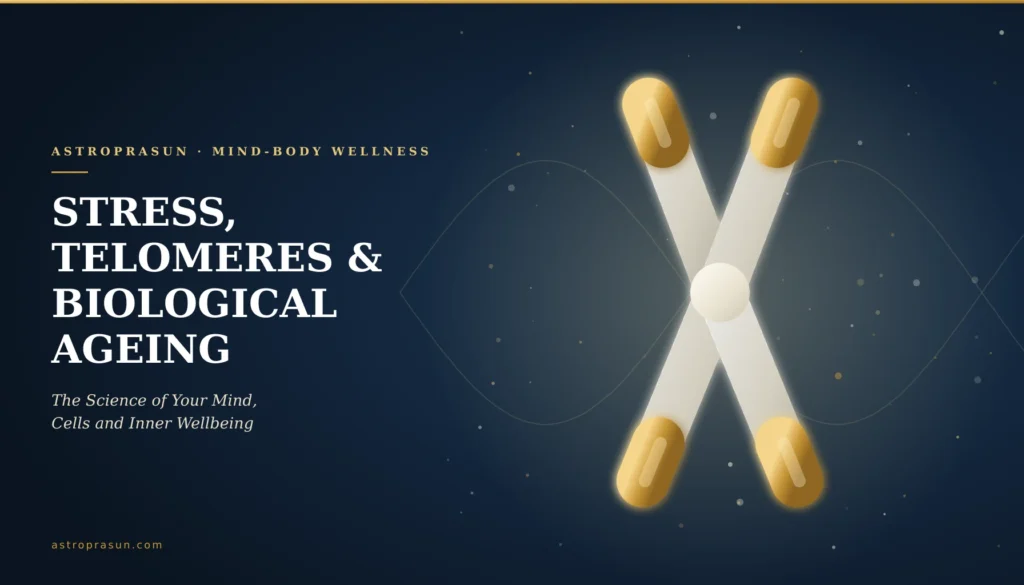
Stress and Telomeres: Does Your Mind Age You?
✦ Mind-Body Wellness · Stress Science · Healthy Ageing Stress and Telomeres: Can Your Mental…
Binaural Beats and Mozart Effect: The Facts | AstroPrasun
Sound · Brain · Evidence Binaural Beats and Mozart Effect: What Science Really Says About…
Deep Focus: How to Build Discipline, Master Concentration and Enter Flow
✦ Psychology · Productivity · Self-Mastery Deep Focus: How to Build Discipline, Master Concentration and…
7 Manifestation Techniques That Actually Work
✦ Manifestation · Practical Methods · Self-Growth 7 Manifestation Techniques That Actually Work: A Practical…

How to Manifest Anything You Want: 7 Practical Steps
✦ Manifestation · Practical Spirituality · Self-Growth How to Manifest Anything You Want: 7 Practical…
How Manifestation Works: Science & Upanishads
✦ Spirituality · Vedic Wisdom · Self-Discovery How Manifestation Works: What Science and the Upanishads…