
Deep Focus: How to Build Discipline, Master Concentration and Enter Flow
Motivation starts the work. A system, protected attention and a worthy challenge are what let you finish it.
⚡ Quick Summary
- Meaningful results need a system, not just bursts of motivation.
- Habits make useful behaviour repeatable, even on low-energy days.
- Deep Work means protecting attention for demanding, valuable tasks.
- Flow is deep engagement; you can invite it but never force it.
- Build consistency first, then concentration, then meaningful challenge.
- A 90-day plan turns these ideas into measurable daily practice.
The Attention Crisis: Why Deep Focus Has Become a Superpower
Think about the last time you sat down to do one important thing. Maybe it was a proposal, a chapter of your thesis, or a lesson plan. Within ten minutes, a notification arrived. You checked it “just for a second.” Forty minutes later you were somewhere else entirely, and the important thing had barely moved.
Most of us know this feeling. And honestly? It is rarely a character flaw. It is the predictable result of working inside an environment built to compete for attention.
Here is the paradox of the modern information age. We have more access to knowledge, tools and communication than any generation before us. A student in Kolkata can watch a lecture from a university in Boston. A founder in Dubai can collaborate with a designer in Lisbon. Yet access does not create skill. Knowing where information lives is not the same as understanding it, and understanding is not the same as producing something valuable with it.
Constant availability adds another cost. When messages, meetings and alerts can reach you at any moment, your attention becomes fragmented. Your day fills with small reactions, and the work that actually moves your life forward waits for a quiet hour that never comes.
Busy does not always mean productive
Visible activity and meaningful progress are two different things. A full inbox cleared by noon feels productive. So does a calendar packed with meetings. But ask a harder question: what did I create today that will still matter next month?
Many people measure their day by the number of messages answered, meetings attended or tasks ticked off. These numbers are easy to count, so they become the scoreboard. Yet reacting to requests is different from creating valuable work. The first keeps things running. The second builds something.
Reactive work responds to what arrives: emails, chats, urgent requests. Creative or deep work produces what did not exist before: a strategy, a skill, a manuscript, a product. Both are necessary. Trouble begins when the first crowds out the second completely.
Attention as a personal resource
Attention is the raw material of learning, creativity and good judgement. Complex ideas cannot be absorbed in scattered fragments. To understand a difficult concept, solve a hard problem or write something original, you need continuity: the ability to hold a thread in your mind long enough to follow it somewhere useful.
Repeated interruptions break that thread. Each time you return, you must rebuild where you were. Do this twenty times a day and you may spend much of your effort re-entering the work instead of advancing it.
The hidden cost of fragmented work
Researchers describe several mechanisms behind this. Four are worth knowing in plain language:
- Task switching. Moving between tasks carries a cost. Your mind must reload the goals, rules and details of the new task.
- Attentional residue. Psychologist Sophie Leroy introduced this idea: part of your attention can remain attached to the previous task, especially if it was unfinished.
- Working-memory limits. You can only hold a small amount of information in mind at once. Fragmented work forces you to drop and reload it repeatedly.
- Cognitive load. The more unrelated demands you juggle, the less capacity remains for careful thinking.
Rest matters here too. Adequate sleep and genuine breaks support clear thinking. No technique can fully compensate for a mind that is chronically exhausted.
A caution before we go further. You will sometimes read dramatic claims that phones have “rewired” our brains or permanently destroyed attention spans. The evidence for such sweeping statements is weaker than the headlines suggest. What we can say with confidence is more modest and more useful: fragmented work makes demanding tasks harder, and you can change your conditions to make them easier.
A three-part answer
This article draws on three influential books and weaves them into one practical framework:
- Habits create consistency (Atomic Habits by James Clear).
- Deep Work protects concentration (Deep Work by Cal Newport).
- Flow describes deep, rewarding engagement (Flow: The Psychology of Optimal Experience by Mihaly Csikszentmihalyi).
The three authors did not propose this combined framework together. It is an original, practical synthesis written by AstroPrasun to help readers apply their separate ideas. It is not a scientifically established sequence, and it does not guarantee any particular result. Please read the original books for the full ideas.
The first step towards meaningful productivity is not doing more things. It is learning to direct attention towards the right things. — Prosun Dey · AstroPrasun
Atomic Habits: Build the System That Makes Consistency Possible
James Clear’s central claim in Atomic Habits is simple and quietly radical: small actions, repeated consistently, can produce large changes over time. He compares this to compounding. A tiny improvement looks invisible today. Sustained for months and years, it adds up.
Contrast this with how most of us attempt change. We wait for a surge of motivation, launch an ambitious plan, burn bright for nine days and collapse on the tenth. Motivation behaves like weather. Systems behave like architecture. You cannot control the weather, but you can build a house that stands in it.
There is one more point that frustrates people early on. Results tend to lag behind effort. You may practise for weeks before anything visible changes. This is normal, and it is the reason many people quit just before the payoff begins.
Identity-based habits
Clear distinguishes three levels of goals. Outcome-based goals focus on results (“finish the report”). Process-based goals focus on actions (“write for an hour each morning”). Identity-based goals focus on who you are becoming (“I am someone who does focused work”).
The idea is that every repeated action is a small vote for the kind of person you are becoming. Notice the difference between these two statements:
- “I want to become a focused person.” (A wish.)
- “I complete one focused work session every day.” (Evidence.)
The second sentence builds identity through proof. You do not need to feel like a disciplined person first. You act, and the identity follows the evidence.
The Four Laws of Behaviour Change
Clear organises habit formation into four practical laws. Each answers a different question about why behaviours stick or fade.
| Law | What it means | Practical example for focus |
|---|---|---|
| 1. Make it obvious | Use clear cues. Prepare your space and materials in advance. | Leave your notebook and pen open on the desk the night before. Stack the habit: “After my morning tea, I open my notebook.” |
| 2. Make it attractive | Link the habit to purpose and make the starting ritual pleasant. | Play the same calming instrumental track, use a favourite pen, or work beside a friend who is also studying. |
| 3. Make it easy | Reduce friction. Begin with an action small enough to start without resistance. | Apply the two-minute rule: “Open the document and write one sentence.” Starting is usually the hardest part. |
| 4. Make it satisfying | Get immediate, healthy reinforcement. Notice progress. | Tick a calendar box after each session. Watch your progress without becoming obsessed with an unbroken streak. |
The laws also work in reverse. To weaken an unwanted habit, make it less obvious (hide the app), less attractive (remember what it costs you), harder (log out after every use) and less satisfying (ask a friend to hold you accountable). Notice that none of these require superhuman willpower.
Environment design: make the right action easier
Your surroundings quietly shape your behaviour. If your phone sits beside your keyboard, you will pick it up. If your notebook sits on a shelf in another room, you will skip it. So design the space instead of arguing with yourself:
- Keep the tools for important work ready and visible.
- Remove unnecessary digital and physical distractions from your work area.
- Place cues for desired actions where you will naturally see them.
- Do not rely on willpower alone. Willpower is a poor security guard.
Before you sleep, set up tomorrow’s first focus session. Open the file you will work on, place your notebook on the desk, and move your phone to another room. Tomorrow’s version of you will find the path already cleared.
When you miss a day
Everyone misses days. Illness, travel, family emergencies and festival weeks all interrupt routines. What matters is how quickly you return. Clear offers a helpful guideline: never miss twice. Missing once is an accident. Missing twice begins to look like a new habit.
Treat this as a guideline, not a moral rule. Perfectionism and all-or-nothing thinking do more damage than a missed day ever could. If you miss, do the minimum version the next day and carry on.
A seven-day habit architecture
Try this starter exercise for one week:
- Choose one important focus habit. For example, one session of focused work on your most valuable task.
- Define a clear cue and time. “At 7:00 a.m., after my tea.”
- Prepare the environment. Set up the workspace the evening before.
- Set a small minimum version. Even ten minutes counts on a hard day.
- Track completion for seven days. A simple tick on a calendar is enough.
- Review. What made the habit easier? What made it harder? Adjust one thing.
Consistency becomes reliable when the environment and the system support the behaviour, instead of leaving everything to motivation. — Prosun Dey · AstroPrasun
Deep Work: Train Your Ability to Concentrate
Computer scientist Cal Newport defines Deep Work as professional activity performed in a state of distraction-free concentration that pushes your cognitive abilities to their limit. Such efforts, he argues, create new value, improve your skills and are hard to replicate.
Its counterpart is shallow work: logistical, routine or easily interrupted tasks that do not demand your full capacity. Replying to routine messages, formatting slides, scheduling meetings. Shallow work is not worthless. Someone has to do it. The problem arises when it fills the entire day and leaves no room for anything deeper.
Why concentration is hard to protect
Look honestly at what competes for your focus:
- Notifications and open communication channels.
- Frequent task switching between tabs, apps and conversations.
- The expectation of immediate replies at work.
- Unplanned browsing and digital consumption.
- The habit of filling every quiet moment with stimulation: the queue, the lift, the pause between tasks.
That last one deserves attention. If you reach for your phone at every pause, your mind never practises sitting with one thing. Concentration, like any capacity, weakens when it is never exercised.
Many people try to do Deep Work in a high-interruption environment and conclude that they “just can’t focus.” Often the real issue is the setup, not the person. Fix the conditions before blaming yourself.
The four Deep Work philosophies
Newport describes four ways of fitting deep work into a life. They suit different people, so choose a realistic one rather than copying someone else’s.
| Philosophy | How it works | Best suited to |
|---|---|---|
| Monastic | Remove or sharply limit shallow obligations to protect long periods of deep work. | Writers, researchers and others whose value comes from a single deep output. |
| Bimodal | Divide time into clearly defined deep-work stretches and periods for everything else. | People who can reserve whole days or weeks, such as consultants or academics. |
| Rhythmic | Build a regular daily or weekly routine, such as the same two hours every morning. | Most professionals, students and business owners. A good starting point. |
| Journalistic | Switch into deep work whenever free time appears in your schedule. | Experienced practitioners only. It demands strong focus habits and is hard for beginners. |
If you are unsure, begin with the rhythmic approach. A fixed time slot removes the daily decision about when to work, and that alone saves energy.
The four rules of Deep Work
Rule 1 — Work deeply. Schedule your sessions instead of hoping time will appear. Create a consistent starting ritual, such as the same desk, the same drink and the same opening action. Decide in advance what the session must accomplish. “Work on the report” is vague. “Draft the methodology section” is a target.
Rule 2 — Embrace boredom. Practise not reaching for your phone during every pause. Build tolerance for stretches without novelty. Try a simple exercise: stand in a queue for five minutes without any screen and see what your mind does. This feels slightly uncomfortable at first. That discomfort is the training.
Rule 3 — Quit or selectively use distracting digital tools. Do not treat every available app as necessary. Ask of each tool: does it clearly support something important in my life? Use social media and messaging intentionally, with set times, instead of as a background hum.
Rule 4 — Drain the shallows. Batch routine tasks into set windows, such as answering email at fixed times. Set boundaries around messaging. Reduce low-value commitments where you can, and say no to requests that do not serve your priorities.
Time blocking: assign tasks to specific calendar slots. Single-tasking: one task, one window. Phone-free periods: keep the device out of reach. Notification and website controls: mute and block during sessions. A dedicated workspace: even a corner of a room helps. A clear task definition: know what “done” means before you start. A shutdown ritual: end the workday with a short review and a note for tomorrow so your mind can release the work.
A realistic weekly Deep Work plan
Suppose you work a demanding job and have family responsibilities. Do not begin with four hours a day. Try this instead:
- Start with three to five focused sessions per week.
- Choose one meaningful task for each session.
- Increase duration gradually, according to your capacity.
- Review the quality of your output, not only the hours logged.
Hours are a poor measure. An hour of genuine concentration can outweigh three hours of half-attention.
Concentration is a capacity that can be supported and practised. It becomes reliable when time, environment and task are deliberately structured. — Prosun Dey · AstroPrasun
Flow: Understand the Psychology of Deep Engagement
Psychologist Mihaly Csikszentmihalyi (pronounced roughly “MEE-high CHEEK-sent-me-HIGH-ee”) spent decades studying what people describe as their best moments. Surgeons, rock climbers, chess players, musicians, factory workers. Different lives, strikingly similar accounts. They described being completely absorbed in what they were doing, so involved that effort felt natural and the hours slipped by. He called this experience Flow.
In Flow, attention becomes strongly absorbed in the task, and the activity feels rewarding in itself. Be careful with the definition, though. Flow is not simply relaxation. It is not excitement. It is not working fast. A person can be calm and idle without Flow, or frantic and busy without it. Flow involves demanding, engaged attention.
Csikszentmihalyi used the word autotelic (aw-toh-TEL-ik), from the Greek auto (self) and telos (goal). An autotelic activity is one you do for its own sake. The reward is the experience itself, not the payment, praise or prize that might follow.
The nine dimensions commonly associated with Flow
Researchers who build on his work usually describe Flow through nine dimensions. Not everyone experiences all nine in the same way, and you do not need a perfect score to benefit. Treat the list as a map of the territory, not a checklist.
| Dimension | What it means in plain language |
|---|---|
| 1. Challenge-skill balance | The task stretches your abilities without overwhelming them. |
| 2. Action-awareness merging | Your attention is absorbed in doing, with little left over for commentary. |
| 3. Clear goals | You know what you are trying to accomplish right now. |
| 4. Immediate feedback | Progress or errors become visible while you work. |
| 5. Concentration on the task | Your attention is strongly focused on what you are doing. |
| 6. Sense of control | You feel a sense of agency over your actions. |
| 7. Reduced self-consciousness | Worry about how you appear fades into the background. |
| 8. Altered time perception | Time may seem to speed up, or occasionally slow down. |
| 9. Autotelic experience | The activity feels rewarding in itself. |
The challenge-skill balance
The most useful practical idea in Flow research is the balance between difficulty and ability. Picture two dials: how hard the task is, and how skilled you currently are. Their relationship shapes how the work feels.
| Your skill | Task challenge | Likely experience |
|---|---|---|
| High | Low | Boredom |
| Low | High | Anxiety or overwhelm |
| High | High, and well matched | Greater possibility of Flow |
| Low | Low | Apathy or disengagement |
This table is a teaching tool, not a diagnostic test. Real experience is messier, and individual differences are large. The useful lesson is that the ideal challenge moves. As your skill grows, yesterday’s stretch becomes today’s comfort, so the work must grow with you.
Consider a harmonium student in Kolkata learning a new raga. If the piece is far too easy, she drifts. If it is far beyond her, she freezes. When it sits just beyond her current ability, with clear notes to hit and instant sound to tell her if she hit them, her attention gathers. That is the zone where Flow becomes possible.
Intrinsic motivation and meaningful engagement
People work for two broad kinds of reasons. Extrinsic reasons come from outside: salary, marks, approval. Intrinsic reasons come from within: curiosity, mastery, the pleasure of the activity. Self-determination research suggests that autonomy (a sense of choice), competence (a sense of growing ability) and meaningful purpose all support healthy motivation.
Do not conclude that external rewards are bad. Salaries pay rent, and exam results open doors. The point is that work which carries some intrinsic meaning tends to hold attention more easily than work you find entirely pointless. If you can connect a task to something you care about, even a small thing, you give your focus something to attach to.
How to create conditions that support Flow
You cannot command Flow, but you can prepare the ground:
- Define a clear, immediate goal for the session.
- Choose a task that is challenging but manageable.
- Remove avoidable distractions before you begin.
- Arrange timely feedback, so you can see how you are doing.
- Work in a setting that supports concentration.
- Build your skills progressively, so challenge can rise over time.
- Allow enough time for immersion. Flow rarely arrives in a ten-minute gap.
No timer, playlist or productivity hack guarantees Flow. If you sit down demanding the state and judge yourself when it does not appear, you add self-consciousness, which is the opposite of what Flow needs. Prepare the conditions, then focus on the quality of the practice. If Flow shows up, welcome it. If it does not, the work still counts.
Flow becomes more likely when attention, skill, challenge, feedback and meaning come together. You prepare the room. You cannot order the guest. — Prosun Dey · AstroPrasun
Integrating the Three Books: A Unified Architecture for Focus
Each book answers a different question. Taken alone, each leaves a gap. Habits without protected attention produce shallow routines. Concentration without consistency flares and fades. Challenge without either becomes a one-off burst. Together they cover more ground.
| Book | Main contribution | The practical question |
|---|---|---|
| Atomic Habits James Clear |
Consistency through systems and behaviour design | How do I show up regularly? |
| Deep Work Cal Newport |
Protecting attention for demanding work | How do I concentrate without interruption? |
| Flow Mihaly Csikszentmihalyi |
Deep engagement and optimal experience | How can I become fully absorbed in a meaningful challenge? |
The three-stage practical architecture
Here is the applied framework this article proposes. Think of it as building a house. Habits are the foundation, protected attention is the walls and roof, and meaningful challenge is what makes the house worth living in.
- Build the habit. Establish a repeatable time and a starting ritual.
- Protect the focus. Remove distractions and work on one clearly defined task.
- Increase meaningful challenge. Practise at the edge of your current ability and use feedback to improve.
This three-stage architecture is an applied framework inspired by the books. It is not a fixed scientific progression, and the authors did not propose it together. Your own experience may call for a different order, and that is fine.
A practical example: learning programming
Suppose you want to learn to code while holding a full-time job in Bengaluru, Pune or London. Here is how the three ideas work together:
- Habit: schedule a manageable daily coding session, say 45 minutes at 6:30 a.m. after your tea.
- Deep Work: close unrelated tabs, silence notifications and work on one feature only.
- Flow-supporting challenge: choose a problem slightly above your current skill, define what success looks like and test the result.
- Feedback: run the code, read the errors and improve it.
- Reflection: note what you learned and what to attempt next.
Applying the framework elsewhere
The same logic travels well. A writer fixes a daily slot, shuts off the internet and sets a section as the target. A teacher blocks preparation time, works on one lesson and tests it in class for feedback. A musician practises at a set hour, isolates one difficult passage and records herself to hear the gap. An entrepreneur protects a morning for strategy and measures outcomes instead of activity. A creator separates ideation from editing. A professional builds a skill by taking on a project slightly above their level.
Build consistency first. Protect the attention that meaningful work needs. Then make the work hard enough to help you grow. — Prosun Dey · AstroPrasun
The 90-Day Deep Focus Transformation Plan
Treat this as an experiment, not a verdict on your character. Adapt it to your job, your health and your family. The aim is to turn broad ideas into behaviour you can observe, and to learn from what you observe.
Phase 1 · Days 1–30: Build Consistency
Primary influence: Atomic Habits.
Choose one high-value activity. Set a consistent cue and time. Prepare the environment each evening. Begin with a realistic minimum session. Track completion and review obstacles weekly.
Measure: planned sessions completed · days the environment was prepared · most common obstacle · one adjustment made each week.
Phase 2 · Days 31–60: Strengthen Concentration
Primary influence: Deep Work.
Schedule focused sessions. Define one outcome per session. Reduce notifications and unnecessary interruptions. Batch shallow tasks. Extend your focus time gradually where it suits you.
Measure: uninterrupted sessions · focus-session duration · meaningful work completed · main source of interruption.
Phase 3 · Days 61–90: Create Conditions for Flow
Primary influence: Flow.
Select appropriately challenging tasks. Define clear goals. Build feedback loops. Raise the difficulty as competence grows. Notice which environments and activities deepen your engagement.
Measure: tasks completed at a suitable challenge level · skills improved · quality of output · your own observations about engagement and concentration.
A sample 65-minute focus session
| Time | Activity |
|---|---|
| 5 minutes | Prepare the workspace, define the goal and remove distractions. |
| 45 minutes | Work on one demanding task. |
| 10 minutes | Take a genuine recovery break. Walk, stretch, look out of a window. Skip the feed. |
| 5 minutes | Record progress and write down the next action. |
Sixty-five minutes is an example, not a universal ideal. No research establishes one session length as best for everyone. Adjust to your needs, health, experience and responsibilities. A student preparing for exams, a parent with a toddler and a founder in a busy quarter will each land somewhere different.
The weekly review
Once a week, sit with five questions. They take ten minutes and they are the engine of the whole plan:
- What did I complete?
- When was my concentration strongest?
- What interrupted me most often?
- Was the task too easy, too difficult or appropriately challenging?
- What one change will I make next week?
In my years of working with clients, I notice that the people who change fastest are rarely the most disciplined. They are the ones who review honestly and adjust one small thing each week. Honest review beats heroic effort.
A 90-day plan turns broad ideas into observable behaviour, and gives you a way to learn from your own experience. — Prosun Dey · AstroPrasun
Deep Focus in Real Life: Students, Entrepreneurs, Creators and the AI Era
For students
Use focused study blocks with a specific learning outcome, such as “solve ten problems on thermodynamics” instead of “study physics.” Practise retrieval and problem-solving rather than only rereading notes, because rereading feels productive without testing what you know. Match the difficulty of your practice to your present ability, and raise it as you improve. This applies whether you are preparing for JEE in Kota or a degree in Melbourne.
For entrepreneurs and business owners
Protect time for strategy, product development and important decisions. Separate deep creative work from routine administration, perhaps mornings for the first and afternoons for the second. Use systems and delegation to cut avoidable task switching. And measure meaningful business outcomes instead of busyness. Revenue from a new product line says more than a hundred answered messages.
For creators and educators
Schedule uninterrupted time for research, writing, lesson design and production. Separate ideation, creation, editing and publishing where it helps, since each asks something different of your mind. Use feedback from readers, students or viewers to improve the work, and let that feedback shape your next challenge.
Deep focus in the age of AI
AI tools can reduce friction. They can help with repetitive work, research organisation, drafting and technical support. Used well, they free time for harder thinking.
Yet they carry their own trap. Constant experimentation with new tools can become another stream of interruptions, and a very respectable-looking one. Keep human judgement, originality, verification and ethical responsibility at the centre. Protect time for the thinking that cannot be outsourced: deciding what matters, evaluating evidence and creating meaningful work.
Ask of each tool: does this reduce friction for my important work, or does it become the work? If you spend more time tuning tools than producing output, treat that as a distraction and adjust.
Technology supports focus when it reduces friction. It undermines focus when it becomes another stream of interruptions. — Prosun Dey · AstroPrasun
Direct Your Attention, Shape Your Future
Let us gather the thread. Habits make useful behaviour repeatable. Deep Work gives important tasks protected attention. Flow describes the possibility of becoming deeply engaged when challenge, skill, feedback and purpose align. Sustainable progress comes from deliberate practice, not from constant motivation or perfection.
You do not need to overhaul your life this week. Start smaller:
- Choose one meaningful task.
- Create one small daily habit around it.
- Protect one focused session.
- Gradually improve the challenge.
- Review your progress after 30 days.
Some weeks will go badly. Return anyway. In a distracted world, learning to direct your attention is one of the most valuable skills you can develop.
Frequently Asked Questions About Deep Focus
What is deep focus?
Deep focus is sustained, undistracted attention directed at one demanding task. It involves protecting your concentration from interruptions such as notifications and task switching, so you can think clearly about difficult material. It is related to Cal Newport’s idea of Deep Work and can sometimes lead to Flow, but it is simply the practice of giving one important task your full attention for a defined period of time.
What is the difference between Deep Work and Flow?
Deep Work, from Cal Newport, is a deliberate practice: protecting distraction-free time for demanding tasks. Flow, from Mihaly Csikszentmihalyi, is an experience: being so absorbed in a well-matched challenge that the activity feels rewarding in itself. You can schedule Deep Work, but you cannot command Flow. Deep Work often creates favourable conditions for Flow, though a deep session does not always produce it.
How can habits improve concentration?
Habits remove the daily decision about when and how to start. If you work at the same time, in the same place, with the same opening ritual, starting needs less willpower. James Clear suggests making the habit obvious, attractive, easy and satisfying. A prepared desk, a fixed time and a small minimum session lower friction, so focused work happens more reliably, including on low-energy days.
How can I create the conditions for a Flow state?
Set a clear, immediate goal. Choose a task that stretches your skill without overwhelming it. Remove avoidable distractions, arrange quick feedback and allow enough uninterrupted time for immersion. Build your skills gradually so the challenge can keep rising. These steps make Flow more likely, but nothing guarantees it. Focus on the quality of practice, and treat Flow as a welcome result, not a demand.
Can concentration be improved through practice?
Yes, for most people concentration improves with deliberate practice and better conditions. Scheduling focused sessions, silencing notifications, working on one task and tolerating boredom without reaching for your phone all help. Sleep, rest and health also matter. Progress varies between individuals, and medical or attention-related conditions may need professional support. Start with short sessions and extend them gradually as your capacity grows.
How many hours of Deep Work should a beginner aim for?
Beginners can start with three to five focused sessions per week, each lasting 30 to 60 minutes, and increase gradually. No research establishes one number of hours as right for everyone. Quality matters more than quantity: one hour of genuine concentration on a single task can outweigh several hours of divided attention. Adjust to your health, workload and experience.
How can I reduce digital distractions?
Silence non-essential notifications, keep your phone out of reach during focus sessions and close unrelated tabs. Check email and messages at set times instead of continuously. Review which apps genuinely serve your goals and limit or remove the rest. Prepare your workspace the evening before. Environment changes work better than willpower, because they make the distracting option harder to reach.
Build a Mind That Can Stay With What Matters
Focus is a skill you can practise, and it grows best with honest reflection and a plan fitted to your life. Explore more learning resources from Prosun Dey at AstroPrasun, and take the first small step today.
Explore AstroPrasun Learning Resources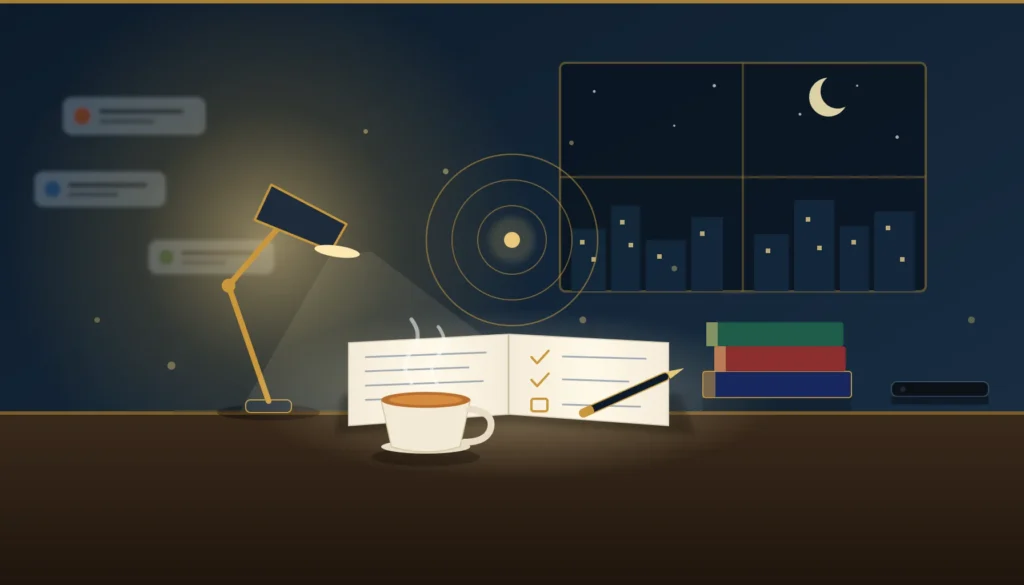
Deep Focus: How to Build Discipline, Master Concentration and Enter Flow
✦ Psychology · Productivity · Self-Mastery Deep Focus: How to Build Discipline, Master Concentration and…
7 Manifestation Techniques That Actually Work
✦ Manifestation · Practical Methods · Self-Growth 7 Manifestation Techniques That Actually Work: A Practical…

How to Manifest Anything You Want: 7 Practical Steps
✦ Manifestation · Practical Spirituality · Self-Growth How to Manifest Anything You Want: 7 Practical…

How Manifestation Works: Science & Upanishads
✦ Spirituality · Vedic Wisdom · Self-Discovery How Manifestation Works: What Science and the Upanishads…

Seeing Snakes in Dreams Meaning
✦ Dreams · Hindu Symbolism · Vedic Astrology Seeing Snakes in Dreams Meaning: Hindu Tradition,…

Auspicious Muhurtha: Select the Right Time | AstroPrasun
✦ Jyotish · Muhurtha · Vedic Electional Astrology Auspicious Muhurtha: How to Select the Right…