
Auspicious Muhurtha: How to Select the Right Time for Important Work According to Vedic Astrology
In Jyotish, time is not the backdrop of your actions — it is an active participant in them. Choosing the right moment is itself a form of wisdom.
⚡ Quick Summary
- Muhurtha (moo-HOOR-tha) is the Vedic science of electional astrology — choosing the most auspicious moment to begin important work.
- A Shubha Muhurtha is evaluated through five simultaneous layers called Panchanga Shuddhi — Tithi, Vara, Nakshatra, Yoga, and Karana.
- The Lagna (rising sign at the chosen time) is considered the spine of any Muhurtha — a strong, unafflicted Lagna is non-negotiable.
- Certain periods — Rahu Kaal, Yamaganda, Gulika Kaal, and Dur Muhurtha — must be actively avoided regardless of how good the other factors look.
- Abhijit Muhurtha (roughly 48 minutes around solar noon) is universally auspicious and available every day without complex chart work.
- Muhurtha does not override karma — it aligns your effort with the natural flow of planetary energy at the right moment.
He signed the documents under a clean Pushya Nakshatra, with a strong unafflicted Lagna and no inauspicious periods overlapping. The business is thriving. Was it the Muhurtha? Was it his preparation? Jyotish would say: both — and the Muhurtha simply let the preparation land where it was meant to.
This is the heart of what Muhurtha teaches. It does not create success from nothing. It removes unnecessary friction from the beginning of an effort — and beginnings, as any experienced practitioner will tell you, carry a disproportionate weight in how the rest of the journey unfolds.
What follows is a complete, practical guide to selecting an auspicious Muhurtha according to Vedic astrology — from the classical five-limb framework down to specific periods to avoid, the universally safe window available every single day, and how to approach different types of important beginnings.
What Is Muhurtha? The Vedic Science of Timing
Muhurtha (Sanskrit: मुहूर्त, also written as Muhurta or Muhoort) is the branch of Jyotish Shastra (Vedic astrology) dedicated to selecting the most favourable moment for initiating important actions. The word itself refers to a unit of time in classical Indian timekeeping — approximately 48 minutes — but in practice it has come to mean any carefully chosen auspicious window for beginning something significant.
Muhurtha (pronounced “moo-HOOR-tha”) means “auspicious moment” or “electional timing” in classical Sanskrit. Shubha (SHOO-bha) means “auspicious” or “good.” Together, Shubha Muhurtha describes a window of time that has been carefully evaluated across multiple astrological factors to confirm its suitability for beginning something important. The classical texts that codify this science include the Muhurtha Chintamani, the Muhurtha Martanda, and relevant sections of the Brihat Parasara Hora Shastra (BPHS).
The foundational principle of Muhurtha is one that Vedic philosophy has held for thousands of years: time is not neutral. Each moment carries a unique energetic signature, shaped by the positions of the Sun, Moon, and planets — and beginning an important action at a moment with a strong, auspicious signature is itself a form of preparation. It doesn’t replace effort. It aligns effort with the natural momentum of the cosmos rather than working against it.
Muhurtha does not guarantee success — it makes success possible by removing friction from the beginning of an effort. — Prosun Dey · AstroPrasun
Panchanga Shuddhi — The Five Limbs of an Auspicious Muhurtha
The foundation of any Muhurtha evaluation is called Panchanga Shuddhi (PAHN-chahn-ga SHOO-dhi) — meaning “purification of the five limbs.” The Panchanga (from pancha = five, anga = limb) is the Vedic almanac, and its five components together describe the quality of any given moment from five distinct astrological angles simultaneously.
A Shubha Muhurtha requires that all five — or at minimum the most critical of the five — be in a favourable condition at once. One strong factor cannot compensate for a severely afflicted one. The framework is evaluative, not additive.
1. Tithi — The Lunar Day
The Tithi is determined by the angular relationship between the Sun and Moon. There are 30 Tithis in a lunar month — 15 in the waxing phase (Shukla Paksha) and 15 in the waning phase (Krishna Paksha). Each Tithi has a ruling deity, an intrinsic quality, and a set of activities it supports or opposes.
| Tithi Number | Name / Type | Nature | Best For |
|---|---|---|---|
| 1, 6, 11 | Nanda Tithis | Auspicious | Joyful beginnings, celebrations, new ventures |
| 2, 7, 12 | Bhadra Tithis | Auspicious | Prosperity-oriented acts, wealth rituals, financial dealings |
| 3, 8, 13 | Jaya Tithis | Auspicious | Competitive activities, sports, victory-seeking work |
| 4, 9, 14 | Rikta Tithis | Avoid | Generally inauspicious — best avoided for new beginnings |
| 5, 10, 15 | Purna Tithis | Auspicious | Completions, fulfilment, long-term initiatives |
2. Vara — The Day of the Week
Each day of the week is ruled by a planet, and that planet’s energy sets the broad tone for activities begun on that day. Choosing a Vara whose ruling planet supports your intention adds a natural tailwind to the effort.
| Day (Vara) | Ruling Planet | Generally Good For |
|---|---|---|
| Sunday (Ravi Vara) | Sun | Government work, authority, health-related matters, spiritual work |
| Monday (Soma Vara) | Moon | Travel, liquids, agriculture, family matters, new beginnings |
| Tuesday (Mangala Vara) | Mars | Courage, competitive activities — generally less auspicious for new ventures |
| Wednesday (Budha Vara) | Mercury | Business, writing, communication, education, accounts |
| Thursday (Guru Vara) | Jupiter | Weddings, ceremonies, learning, financial expansion — one of the most universally auspicious days |
| Friday (Shukra Vara) | Venus | Luxury, art, relationships, beauty, harmony — excellent for social beginnings |
| Saturday (Shani Vara) | Saturn | Long-term structural work, property, farming — less favoured for quick-result activities |
Thursday (Guru Vara) and Wednesday (Budha Vara) are widely considered the most universally favourable days for beginning important auspicious work — Jupiter and Mercury both bring growth, wisdom, and forward momentum without the aggression of Mars or the restriction of Saturn. Monday (Soma Vara) is excellent for anything involving travel, new beginnings, or family.
3. Nakshatra — The Lunar Mansion
The Nakshatra is the star position of the Moon at the time of beginning. The 27 Nakshatras are classified into different types based on their nature, and Muhurtha texts specify which Nakshatras are suitable for which categories of work. Choosing a Moon-Nakshatra that is compatible with your intended activity is one of the most powerful factors in the entire framework.
| Nakshatra | Nature | Best Suited For |
|---|---|---|
| Ashwini, Pushya, Hasta | Laghu (Light) | Travel, medical work, fine crafts, quick activities |
| Rohini, Uttara Phalguni, Uttara Ashadha, Uttara Bhadrapada | Sthira (Fixed) | Coronations, planting, construction, marriage — anything meant to last |
| Swati, Punarvasu, Shravana, Dhanishtha, Shatabhisha | Chara (Movable) | Travel, vehicles, gardening, change-related activities |
| Mrigashira, Chitra, Anuradha, Revati | Mridu (Soft) | Learning, music, arts, friendship, ornaments, auspicious ceremonies |
| Ardra, Ashlesha, Jyeshtha, Moola | Tikshna (Sharp) | Separation, competitive acts — generally avoided for new auspicious beginnings |
Pushya Nakshatra (ruled by Saturn, governed by Brihaspati) is considered the most universally auspicious Nakshatra in classical Muhurtha texts. The classical saying is that even if every other Muhurtha factor is weak, Pushya Nakshatra elevates the timing. It is especially prized for business beginnings, wealth-related activities, and learning. The only notable exception: it is generally not used for weddings in traditional South Indian practice. You can check the current Nakshatra using the free Nakshatra calculator on AstroPrasun.
4. Yoga — The Combined Sun-Moon Position
The 27 Nitya Yogas (daily Yogas) arise from adding the longitudes of the Sun and Moon and dividing into 27 equal parts. Each Yoga has an intrinsic quality that modifies the overall tone of that time period. Unlike the other four limbs, Yogas are not directly observable — they require calculation — but they significantly affect how the Panchanga reads overall.
Siddhi Yoga (accomplishment), Amrita Yoga (nectar — among the most powerful), Shubha Yoga (auspiciousness), and Harshana Yoga (joy) are the most sought-after for new beginnings. Work begun in these Yogas is believed to carry natural momentum toward completion.
Vyatipata Yoga and Vaidhriti Yoga are the two most seriously inauspicious Nitya Yogas and should be avoided for any important beginning — these two alone can outweigh otherwise good factors in the remaining four limbs.
5. Karana — The Half-Tithi
Each Tithi is divided into two Karanas of roughly six hours each. The 11 Karanas cycle through the month, and each has its own character. For Muhurtha purposes, the most important Karana to avoid is Vishti Karana (also called Bhadra) — considered particularly inauspicious for beginning any important work. The ancient texts warn that activities begun during Vishti/Bhadra Karana carry the seed of obstruction from their very first moment.
The Lagna — Spine of Every Muhurtha
Beyond the Panchanga’s five limbs, the Lagna — the ascendant of the elected moment, the zodiac sign rising on the eastern horizon at the precise time of beginning — is the single most important factor in a complete Muhurtha calculation. The classical texts consistently emphasise this. A Panchanga can be largely good, but a severely afflicted Lagna overrides it.
• The Lagna should not be occupied by or aspected by Mars, Saturn, Rahu, or Ketu — especially without a benefic aspect softening the malefic influence.
• The Lagna lord should be well-placed — in a Kendra (1st, 4th, 7th, or 10th house) or Trikona (1st, 5th, or 9th house) of the elected chart — and free from combustion.
• The Moon should not be in the 8th house of the elected Lagna.
• The 8th house itself should ideally be free of planets.
For most ordinary auspicious work — a business registration, a new contract, a Griha Pravesh (housewarming) — a Lagna that is free of malefic influence and whose lord is well-placed is sufficient. For complex events like weddings or major surgical procedures, a far more detailed analysis of the elected chart is needed, often including compatibility with the natal charts of the individuals involved.
Inauspicious Periods to Always Avoid in Muhurtha Selection
A complete Muhurtha check is not only about finding what is good — it is equally about confirming the absence of what is harmful. Several recurring daily periods are considered inauspicious across the board, regardless of how strong the Panchanga or Lagna otherwise appears.
Rahu Kaal — The Period of Rahu
Rahu Kaal (RAH-hoo KAHL) is a daily period of approximately one and a half hours, ruled by Rahu (the North lunar node). Its timing shifts each day of the week. Beginning important work during Rahu Kaal is one of the most widely followed avoidances in daily Indian life — even people who do not follow formal Muhurtha practice are often aware of it.
| Day | Approximate Rahu Kaal Period |
|---|---|
| Sunday | 4:30 PM – 6:00 PM |
| Monday | 7:30 AM – 9:00 AM |
| Tuesday | 3:00 PM – 4:30 PM |
| Wednesday | 12:00 PM – 1:30 PM |
| Thursday | 1:30 PM – 3:00 PM |
| Friday | 10:30 AM – 12:00 PM |
| Saturday | 9:00 AM – 10:30 AM |
The times above are general reference values based on a sunrise of approximately 6:00 AM. Actual Rahu Kaal shifts with your local sunrise time and varies by location. If you are in London, Sydney, or Vancouver, your Rahu Kaal will fall at a different clock time than someone in Chennai or Delhi. Always calculate Rahu Kaal based on your local sunrise for that specific day and city.
Yamaganda and Gulika Kaal
Yamaganda and Gulika Kaal are two additional inauspicious daily periods that follow a similar structure to Rahu Kaal — each lasting approximately one and a half hours, each shifting position by day of the week. Yamaganda is associated with Saturn’s sub-lord Yama (the deity of time and karma) and is considered particularly inauspicious for beginning any new auspicious work. Gulika (the son of Saturn) carries similarly restrictive, delay-heavy energy.
Dur Muhurthas
Each day has two additional short periods called Dur Muhurthas (inauspicious quarter-hours) whose timing depends on the day of the week. These are shorter windows — roughly 15 to 48 minutes — but should still be avoided for beginning any significant auspicious activity.
Rikta Tithis and Vishti Karana
As noted in the Tithi and Karana sections, the 4th, 9th, and 14th Tithis (Rikta Tithis) are generally avoided for new auspicious beginnings. Vishti Karana (Bhadra), whichever half-Tithi it falls in, is a hard avoidance in all classical texts. The Amavasya (new Moon) also carries specific restrictions for most categories of auspicious work.
Abhijit Muhurtha — The Universal Daily Window Available Every Day
Here is the one thing every practitioner of Muhurtha should know for practical daily life: there is one window, available every single day, that Vedic astrology considers universally auspicious without any complex chart calculation. It is called Abhijit Muhurtha (ahb-HEE-jit) — the “victorious moment.”
Abhijit Muhurtha falls roughly in the middle of the day — the 8th Muhurtha of the 15 daytime Muhurthas — centred on solar noon (which is not the same as clock noon; it is the local astronomical midday based on your longitude). In practical terms, this corresponds to an approximately 48-minute window straddling solar noon.
Why it’s powerful: At solar noon, the Sun reaches its highest point in the sky — the 10th house position in the Muhurtha chart. The Sun placed in the 10th house of any chart is a classical marker of visibility, authority, and successful action. Abhijit Muhurtha harnesses this moment every day, making it the single most universally safe window for beginning any auspicious, important activity when detailed chart work is not available or practical.
In my consultations, I always mention Abhijit Muhurtha to clients who find the full Panchanga analysis overwhelming. Even in the middle of a busy week in Mumbai, London, or Dubai — even when you cannot consult a detailed Panchanga — calculating solar noon for your city and beginning your important work within 20–24 minutes of that moment is always a sound choice.
The one exception worth noting: Abhijit Muhurtha is not used on Wednesdays in classical Jyotish, as Mercury and the Sun’s combined energy creates a specific incompatibility on that day. Every other day of the week, it remains fully valid.
Muhurtha by Activity Type — What Changes and What Stays the Same
Different activities require different emphases within the same Panchanga framework. The five limbs remain constant — but which factors matter most shifts depending on what you’re beginning.
Business Registration & New Ventures
Favour Thursday or Wednesday. Pushya, Rohini, or Hasta Nakshatra. Strong Lagna lord in a Kendra or Trikona. Avoid Rahu Kaal, Rikta Tithi, and Vyatipata Yoga. The 10th house of the elected chart should be strong — it governs livelihood and action.
Marriage Ceremonies
Requires the most detailed Muhurtha analysis of any activity. Fixed Nakshatras (Rohini, Uttara Phalguni, Uttara Ashadha) are most commonly used. Venus should not be combust. The 7th house of the elected chart must be strong and unafflicted. Compatibility with both birth charts is essential.
Property Purchase & Griha Pravesh
Favour Sthira (Fixed) Nakshatras — Rohini, Uttara Phalguni, Uttara Ashadha, Uttara Bhadrapada. Thursday or Friday preferred. The 4th house of the elected chart (home and property) should be strong. Avoid Saturn in the Lagna or 4th house.
Education, Examinations, New Courses
Wednesday (Mercury’s day) is strongly favoured. Hasta, Ashwini, or Pushya Nakshatra. A strong Mercury in the elected chart — not combust, not debilitated. The 5th house of the Muhurtha chart — governing learning and intelligence — should be unafflicted.
Not everything requires elaborate astrological timing. For ordinary daily decisions, work already in progress, and non-initiatory tasks (editing an existing document, responding to email, continuing a project already underway), Muhurtha is not necessary or expected. The science applies specifically to beginnings — the moment of initiation — not to every moment of ongoing effort.
When the Muhurtha Chart Contradicts the Natal Chart
For truly significant life events — marriage, business partnership, relocation, or major surgery — classical Jyotish insists on cross-referencing the elected Muhurtha not just against the Panchanga, but against the natal birth chart of the person for whom it is being chosen.
An otherwise excellent Muhurtha can still carry specific friction if, for example, the elected Lagna happens to fall in the natal 8th house, or if the elected chart’s Moon happens to conjunct a natal malefic. And honestly? This is the layer that requires the most experience to navigate — and the reason why personalised Muhurtha analysis remains genuinely different from a generic “good days” calendar.
In Vedic astrology, the birth chart represents the accumulated karma a person carries. A strong Muhurtha can provide excellent cosmic support for an activity, but it cannot override what the natal chart indicates is simply not yet the time for something. This is why I always look at both together — the Muhurtha chart tells us the quality of the chosen moment; the natal chart tells us whether that moment is truly ripe for this specific person.
For major life events — a business launch, a wedding, a property purchase, a medical procedure — a Muhurtha calculated against your specific natal chart gives precision that no general guide can match. Book a personal Jyotish consultation with Prosun Dey for a Muhurtha reading that integrates your birth chart, current Dasha period, and the full five-limb Panchanga analysis together.
Practical Muhurtha — A Simple Daily Approach That Works Without a Specialist
Most people cannot consult a detailed Panchanga every day. And honestly, for ordinary daily work, they shouldn’t need to. Here is a practical, layered approach that works for most situations without requiring specialist knowledge.
- Check the day. Is it Thursday, Wednesday, or Monday? Strong start. Is it Tuesday or Saturday? Not ideal for new auspicious beginnings — plan accordingly if possible.
- Check Rahu Kaal for your city and date. Do not begin anything important in this window. This is the single most practically important avoidance in daily Muhurtha practice.
- Check the Tithi. Is it a Rikta Tithi (4th, 9th, or 14th)? Avoid beginning important new work. Most Indian calendar apps and Panchanga websites display the current Tithi easily.
- Use Abhijit Muhurtha as your safety net. If you need to begin something important and cannot check everything else — find solar noon for your city and begin within 20–24 minutes of it.
- For major events, go deeper. Consult the full Panchanga and ideally get a personalised reading that integrates your natal chart, current Mahadasha and Antardasha period, and the elected Muhurtha chart together.
I tell clients this often: Muhurtha is like choosing the right tide for launching a boat. A skilled sailor can launch in any condition — but why work against the water if you don’t have to? The effort doesn’t disappear. You are still the one sailing. Muhurtha just puts you in the water at the right moment. That’s all. Nothing more.
Frequently Asked Questions — Auspicious Muhurtha in Vedic Astrology
What is Muhurtha in Vedic astrology?
Muhurtha is the branch of Jyotish Shastra (Vedic astrology) dedicated to selecting the most auspicious moment to begin important activities — a business, a marriage, a journey, a property purchase, or any other significant initiation. It evaluates the quality of a chosen moment through five simultaneous astrological layers called Panchanga Shuddhi, along with the Lagna (rising sign) of the elected moment. The classical texts that codify this system include the Muhurtha Chintamani and the Brihat Parasara Hora Shastra.
How is an auspicious Muhurtha calculated?
A Shubha Muhurtha is calculated by evaluating five simultaneous factors — Tithi (lunar day), Vara (day of week), Nakshatra (Moon’s star position), Yoga (combined Sun-Moon position), and Karana (half-Tithi) — along with the Lagna (rising sign) of the elected moment. The practitioner confirms that all five are in a favourable condition at once, that Rahu Kaal, Yamaganda, and Dur Muhurtha periods are avoided, and ideally that the elected chart is also compatible with the natal birth chart of the person beginning the activity.
What is Abhijit Muhurtha and when does it occur?
Abhijit Muhurtha is a universally auspicious window of approximately 48 minutes centred on solar noon — when the Sun reaches its highest point in the sky, naturally occupying the 10th house position of the Muhurtha chart. It is available every day without complex chart calculation and is considered the single safest daily window for beginning important auspicious work when a detailed Panchanga analysis is not available. Classical texts generally exclude Wednesday from Abhijit Muhurtha usage.
What is Rahu Kaal and why should it be avoided?
Rahu Kaal is a daily period of approximately 1.5 hours ruled by Rahu (the North lunar node), whose energy is considered inauspicious for beginning new important activities. Its position shifts each day of the week and is calculated based on the local sunrise time for your specific city. Activities begun during Rahu Kaal are believed to inherit Rahu’s characteristic disruption, delays, and unpredictability — making it one of the most widely observed avoidances in daily Indian astrological practice.
Which Nakshatra is best for a Shubha Muhurtha?
Pushya Nakshatra is widely regarded as the most universally auspicious Nakshatra for beginning important work — classical texts say it elevates the Muhurtha even when other factors are weak. Other highly favoured Nakshatras include Rohini (excellent for lasting endeavours), Uttara Phalguni and Uttara Ashadha (strong, fixed energy for stable beginnings), Hasta (ideal for skilled work and travel), and Ashwini (for speed and new initiatives). The choice of Nakshatra is also activity-specific — what is ideal for a marriage differs from what is ideal for a business launch.
Does Muhurtha work without a birth chart?
A basic Muhurtha — checking the Panchanga, avoiding Rahu Kaal and inauspicious Tithis, and using Abhijit Muhurtha as a daily safety net — works without a birth chart and is widely practised this way in daily life. However, for major life events like marriage or a significant business launch, cross-referencing the elected Muhurtha against the natal birth chart adds a crucial layer of personalisation that a generic good-timing guide cannot provide. The full reading considers current Mahadasha, natal strengths, and the specific event’s astrological requirements together.
Can a bad Muhurtha ruin a good event?
A significantly inauspicious Muhurtha — Rahu Kaal, Rikta Tithi, Vyatipata Yoga, and a severely afflicted Lagna all appearing together — can add real friction to an event, particularly in how it begins or sustains itself over time. However, Jyotish does not teach that Muhurtha alone determines outcomes. A person’s natal karma, effort, preparation, and current planetary period all carry at least as much weight. A poor Muhurtha makes things harder; a good Muhurtha makes things smoother — neither is the whole story.
Is Muhurtha relevant for people living outside India?
Yes, entirely. Rahu Kaal, Tithi, Nakshatra, and Abhijit Muhurtha are all calculated based on local sunrise time for any location on earth — the system is not geographically limited to India. Many practitioners in the UK, the US, Canada, Singapore, and the UAE use Muhurtha regularly for personal and professional decisions. The key is to use the correct local sunrise for your city when calculating daily inauspicious periods, rather than using India-based timings that won’t apply to your location.
Final Thoughts — Aligning Your Effort With the Right Moment
Muhurtha is not a superstition. It is a framework for intention — a way of saying, consciously, that you will not begin something important in whatever random moment happens to be available, but in a moment that has been evaluated, considered, and found to be genuinely supportive of what you are trying to do.
The Vedic tradition teaches that time itself is alive — Kaal, the supreme force — and that each moment carries a distinct energetic quality. Reading that quality before you step into it is one of the most practical applications Jyotish offers for daily life. Not instead of preparation, effort, or good judgment. Alongside them. Always alongside them.
To explore the Nakshatra energies more deeply as they apply to your birth chart, you can check the Lucky Nakshatra Calculator or find your precise Nakshatra position using the Nakshatra Pada Calculator on AstroPrasun. For a complete Muhurtha reading integrated with your natal chart and current Dasha period, a personalised consultation gives you the precision that no general guide can offer.
Want a Muhurtha Calculated for Your Specific Event and Birth Chart?
A general Panchanga check tells you whether the day is broadly favourable — but a truly personalised Muhurtha integrates your natal chart, your current Mahadasha and Antardasha period, the specific nature of your event, and the full five-limb Panchanga together. For important beginnings, that precision is worth seeking.
🌐 astroprasun.com · 📧 contact@astroprasun.com
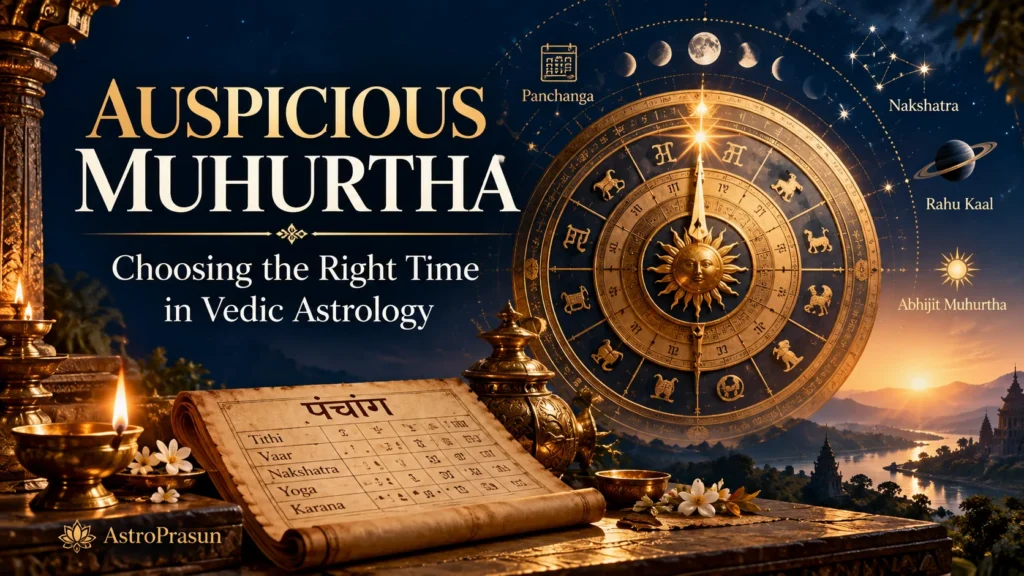
Auspicious Muhurtha: Select the Right Time | AstroPrasun
✦ Jyotish · Muhurtha · Vedic Electional Astrology Auspicious Muhurtha: How to Select the Right…

Toxic Mobile Number Combinations to Avoid
✦ Numerology · Mobile Number · Caution & Remedies Toxic Mobile Number Combinations You Should…

Lucky Mobile Number by Date of Birth | AstroPrasun
✦ Numerology · Mobile Number · Date of Birth Compatibility Lucky Mobile Number According to…