
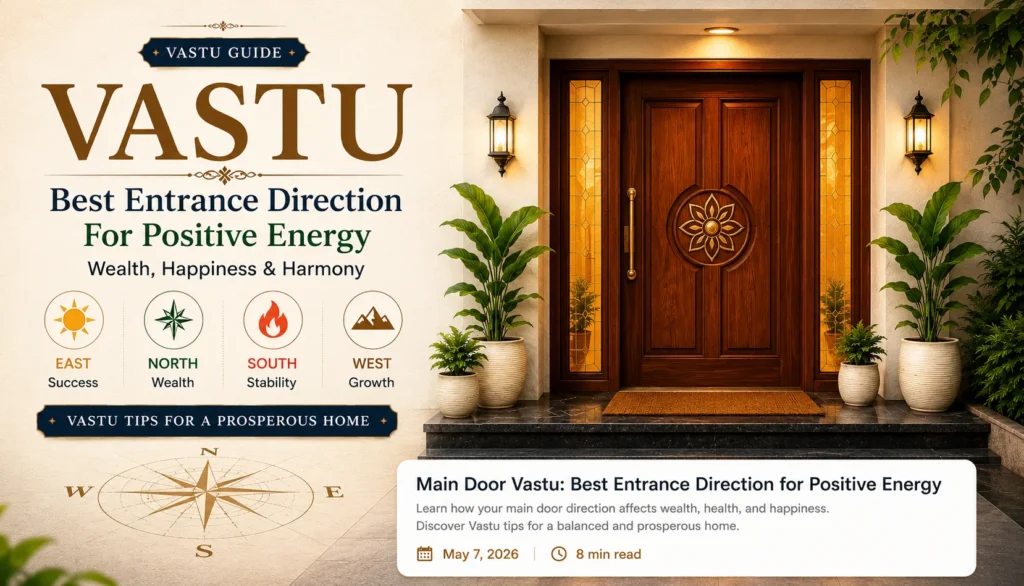
Main Door Vastu: Best Entrance Direction for Positive Energy and Luck
How the direction, placement, design, and energy of your main door quietly shapes the health, wealth, relationships, and fortune of every person living inside.
⚡ Quick Summary
- The main door is the single most important Vastu element in any home — called the Simhadwar, it is the primary gateway for all incoming energy.
- The best directions for a main door are North, North-East, and East — each governed by deities of wealth, growth, and new beginnings.
- Direction alone is not enough — the exact pada (energy field) within that direction, as per the 32-entrance Vastu Purusha Mandala, determines the real result.
- South and South-West entrances are the most challenging and require specific remedies — they are not automatically fatal if the correct pada is chosen.
- Design details matter deeply — wood material, clockwise opening, odd number of steps, threshold, nameplate, and colours all contribute to the door’s Vastu compliance.
- For existing homes with non-ideal doors, powerful non-structural remedies exist — no demolition needed.
Suresh had bought his dream flat in Pune — 3BHK, good floor, great view. Within 18 months of moving in, three things happened: his business revenue dropped by almost 30%, his wife developed recurring health issues, and a minor family dispute turned into a long-standing rift with his brother. He came to me not believing in Vastu at all. He came because he was desperate.
The first thing I asked him was not his birth date. I asked: “Which direction does your main door face?” He said South-West. I asked for the floor plan. Sure enough — the entrance sat squarely on what the ancient text Vishwakarma Prakash calls the Pitru pada. The zone of ancestral energy, debt, and obstruction.
We did not break a single wall. Three practical, non-structural corrections. Twelve months later, Suresh sent me a message: “Business is back. Wife is recovering. I still don’t fully understand why it worked. But it worked.”
That is what main door Vastu actually is — not superstition, not magic. It is the ancient science of understanding how directional energy, solar radiation, geomagnetic fields, and spatial psychology interact at the most critical threshold of your home.
What Is Main Door Vastu? Understanding the Simhadwar
Pronounced Sim-ha-dwaar. Literally “Lion’s Gate.” In Vastu Shastra, the main entrance of any structure is called the Simhadwar — the primary point of energy entry. Just as a lion guards what is precious, the main door is both a protector and an attractor. It decides the quality, quantity, and character of energy that flows into every room, relationship, and ambition inside the home.
Vastu Shastra — the ancient Indian science of sacred architecture — treats a building as a living organism. The Vastu Purusha, the cosmic being whose body maps onto every plot of land, has a mouth. That mouth is the main door. Whatever enters through that mouth nourishes or poisons the entire body of the home.
This is not poetic metaphor. It is functional spatial science. In my years of working with clients across India — from independent bungalows in Kolkata’s residential belts to high-rise flats in Mumbai — one observation holds consistently: families living in homes with correctly placed main doors report fewer chronic financial struggles, better health patterns, and more stable relationships. The entrance is the foundation of the entire Vastu equation.
“Fix the entrance first. Everything else in Vastu is secondary to where and how energy enters the home.”
The classical Vastu text Vishwakarma Prakash documents 15 specific methods for determining the ideal door position. The most widely used system today is the 32-pada model based on the Vastu Purusha Mandala — a 360-degree division of any plot into 32 equal energy zones of 11.25 degrees each, governed by 32 different cosmic deities. Each deity carries a specific quality — some bring wealth, some bring conflict, some bring fame, and some bring disease.
Why the Main Door Direction Matters More Than You Think
Here is something most people misunderstand: the facing of your house and the direction of your main door are not always the same thing. Many people assume that if they live in an “East-facing” home, their main door faces East. That is often false. And this confusion leads to wrong Vastu assessments.
Stand at the approximate center of your home. Use a compass. Face your main door. That compass reading — not your building’s road-facing direction — is your true main door direction. The difference can be 30 to 45 degrees in many apartments, especially corner flats and irregularly built complexes.
From a modern spatial science perspective, the reason directional placement matters is grounded in three real physical principles. First, solar radiation patterns — East and North-East entrances receive morning sunlight, which is rich in beneficial UV frequencies, supports circadian rhythm, and psychologically signals openness and beginning. Second, geomagnetic field alignment — the Earth’s magnetic field flows broadly from South to North; North-facing entrances work with this natural flow rather than against it. Third, wind and airflow — directional entrances determine the natural cross-ventilation patterns inside a home, which directly impacts air quality, humidity, and the felt sense of spaciousness.
Ancient Vastu masters encoded all of this in the language of deity, direction, and energy — because that was the communication system of their time. The physics was always there underneath.
Main Door Direction Guide: All 8 Directions, Their Energy and Vastu Verdict
Here is a complete directional reference for main door placement as per Vastu. This goes beyond the oversimplified “North is good, South is bad” advice you find everywhere. Each direction carries nuance.
| Direction | Ruling Deity / Element | Energy Quality | Life Areas Influenced | Vastu Verdict |
|---|---|---|---|---|
| North | Kubera · Water element | Magnetic, prosperity-attracting, steady flow of resources | Finances, career, business, professional growth | Highly Auspicious |
| North-East | Lord Shiva · Water + Space | Spiritual, clarifying, divine blessings, mental peace | Wisdom, health, clarity, spiritual growth | Most Sacred |
| East | Lord Indra · Sun energy | Rising energy, new beginnings, social expansion, vitality | Health, social connections, career visibility, reputation | Highly Auspicious |
| West | Lord Varun · Water | Neutral-stable, steady but slow-moving energy | Stability, security, creative growth — with remedies | Acceptable |
| South-East | Agni (Fire God) · Fire | Fiery, reactive, tension-generating — especially for women | Health of women in family, relationship friction, financial irregularity | Needs Remedies |
| South | Yama · Earth | Heavy, karmic, intense — specific padas S3 & S4 are beneficial | Fame and finance (S3/S4 only); otherwise instability | Pada-Dependent |
| North-West | Vayu (Wind God) · Air | Unstable, transient energy — movement and impermanence | Travel, legal issues, lack of settlement, frequent change | Caution Advised |
| South-West | Nairriti / Rahu · Earth | Heavy Rahu energy — karmic pressure, debt, obstruction | Chronic financial struggle, debt cycles, health burden | Avoid / Correct |
The 4 Most Important Directions for Main Door Vastu — A Deep Dive
🔵 North Facing Door — Kubera’s Gate
Ruled by Kubera, the god of wealth, North entrances are magnets for financial energy. Auspicious padas: N3 (Mukhya) — best for money and family prosperity; N4 (Bhallat) — abundance and blessings; N5 (Soma) — wealth and spiritual elevation. Avoid N1 (Roga) and N2 (Naga) — these bring enmity, illness, and fear. Best suited for: finance professionals, businesspeople, and families seeking material stability.
🟡 East Facing Door — Indra’s Sunrise Gate
East represents the rising Sun — new beginnings, health, and social authority. Auspicious padas: E3 (Jayanta) — goal achievement and network expansion; E4 (Indra/Mahendra) — power, government connections, strong authority. Avoid E1 (Agni) and E2 (Jayant-south) — these bring financial fire and conflict. East doors receive morning sunlight, regulate circadian rhythms, and psychologically create a sense of openness and opportunity.
🟣 West Facing Door — Varun’s Steady Gate
Often misunderstood, West entrances are acceptable and can be excellent for specific padas. Auspicious padas: W3 (Sugreev) — steady growth; W4 (Pushpdant) — prosperity and pleasant life; W5 (Varun) — abundance and social harmony. Avoid the South-West portion of the West wall. West doors suit creative professionals, service industries, and those in education or healing. A metal nameplate and white or blue door colour strengthen West-door energy.
🔴 South Facing Door — Yama’s Gate
The most misunderstood direction in popular Vastu. While broadly challenging, padas S3 (Vitatha) and S4 (Grihrakshita) are genuinely prosperous — S4 is ideal for fame, media, and public recognition. The real danger zones are S6 (Gandharva) — poverty and defamation — and S8 (Niruti) — the most inauspicious of all 32 padas. If your South door falls in S3 or S4, you may have a stronger foundation than you realise. If it falls elsewhere, specific remedies are non-negotiable.
Main Door Design Rules as Per Vastu: Material, Size, Colour, and Position
Direction is the foundation. But the design of the door itself is the architecture on top of that foundation. In consultations, I often see people who have a good directional placement but a poorly designed door — and they wonder why the results are mixed. Here is what the classical texts and practical experience say.
Material — Why Wood Is the Only First Choice
The unanimous preference in Vastu Shastra is solid natural wood — ideally teak (sagwan) for its density, durability, and grounding energy. Wood belongs to the earth-growth element. It absorbs vibration, creates warmth, and acts as a natural energy buffer between outer turbulence and inner sanctuary. Avoid full metal or full glass main doors — metal creates harsh energy reflections, and glass allows energy to pass without filtering.
Size — The Door Must Be the Largest in the Home
This rule is both energetic and psychological. The main door must be visually dominant — larger than every interior door. A small, cramped entrance signals restriction — to the subconscious of everyone who enters and to the energy field of the home. The ideal proportions are a height-to-width ratio of roughly 2:1. Double-shutter doors (two panels) are considered the most auspicious as they allow maximum energy inflow and create visual grandeur.
Opening Direction — Always Clockwise, Always Inward
The door must open inwards and clockwise. This is one of the clearest alignments in all of Vastu and there is a functional reason: an inward-opening door invites energy into the home rather than pushing it away. Clockwise movement aligns with the Sun’s apparent movement across the sky — and with the natural swirling direction of most beneficial energy patterns in the Northern Hemisphere.
Colour — Match the Direction, Not Just Your Décor Preference
| Door Direction | Best Colours | Colours to Avoid | Why |
|---|---|---|---|
| North | Blue, Green, Silver, Cream | Red, Dark Brown | Blue and green align with Kubera’s water element; amplify prosperity flow |
| North-East | Cream, Yellow, Light Green | Black, Dark Grey | Light earth tones support the spiritual clarity of the Ishan zone |
| East | Wooden tones, Light Blue, White | Black, Deep Red | Neutral warm tones support the Sun’s rising energy without intensifying it |
| South-East | Orange, Pink, Silver | Blue, Green | Fire element needs warm colour support — cool colours create elemental conflict |
| South | Red, Yellow, Pink | Black, Dark Blue | Yama’s heavy energy benefits from warming, activating colours |
| West | White, Blue, Silver | Red, Bright Orange | Varun’s water element is supported by cool, calm tones |
| South-West | Yellow, Earthy Brown | Black, Dark Red | Earth tones stabilise Rahu’s unstable energy; dark colours amplify heaviness |
The 5 Most Powerful Main Door Vastu Details Most People Overlook
🪵 The Threshold (Dehleez)
A raised wooden or marble threshold at the main entrance is not decorative — it is functional. The threshold creates a slight energetic boundary between the outer world and inner sanctuary. It physically prevents the entry of insects and symbolically prevents the “leakage” of prosperity. Never remove an existing threshold. If yours is broken or damaged, replace it immediately.
🪧 The Nameplate
A clearly visible nameplate at the main entrance is one of the simplest yet most powerful Vastu activators. It establishes identity — energetically telling the universe exactly whose home this is and what energy it belongs to. For North and East doors, brass or copper nameplates amplify the positive directional energy. For South and West doors, wooden nameplates are more appropriate.
💡 Lighting at the Entrance
A well-lit entrance is non-negotiable. Darkness at the main door is one of the fastest ways to suppress incoming positive energy. Use warm, welcoming light — not harsh white fluorescents. A lamp or warm LED above the door frame that illuminates the entrance area clearly, including the nameplate and threshold, is ideal. In many Indian homes, a small diya (oil lamp) near the entrance in the evening is one of the most powerful energetic activators available.
🔇 The Door Must Open Silently
A squeaky or noisy main door is a Vastu defect. In classical texts, this is called an ashubha dhwani — an inauspicious sound at the threshold. The practical reason is immediate: a difficult or noisy door subconsciously signals resistance, struggle, and friction every single time someone enters your home. Well-oiled, smooth-functioning hinges create ease of movement — and energetically that ease of entry extends to opportunities in the home’s life.
🪴 Plants and Symbols at the Entrance
A Tulsi plant or a money plant near the main entrance purifies incoming air (scientifically validated) and energetically cleanses prana before it enters. Auspicious symbols — the Swastika, the Om symbol, or a Ganesh idol — on or beside the main door act as vibrational anchors, setting the energetic tone for the entire home. Avoid thorny plants, cactus, and artificial flowers directly at the entrance.
🪞 What NOT to Place at the Entrance
Mirror directly opposite the main door — reflects incoming positive energy straight back out. Dustbins or shoe racks immediately beside the door — associate the first energetic impression of your home with disposal and dirt. Broken pots, peeling paint, or damaged walls near the entrance — represent neglected energy and signal decline. A staircase directly facing the main door — creates a “drain” that pulls energy upward rather than allowing it to settle and circulate in the living space.
Main Door Vastu Remedies for Challenging Directions — No Structural Changes Needed
And honestly? This is the section that most people actually need. Because most of us do not choose the direction of our main door. We buy or rent a home and work with what we have. Here is what genuinely works — based on classical Vastu texts and real case observations across hundreds of consultations.
For South-Facing Doors
- Place a metal strip (brass or copper) across the threshold of the door frame — this creates a metallic buffer that moderates heavy Yama energy.
- Paint the door in red or yellow — activating, warming colours that counterbalance the heaviness of the South.
- Place a Swastika symbol or a Ganesh idol on the outer face of the door to establish divine protective energy at the threshold.
- Ensure the entrance is extremely well-lit — darkness at a South door amplifies its negative potential significantly.
- Always keep a second door open in the North direction of the home — classical Vastu for South-facing homes requires a counter-flow of North energy inside.
For South-West Facing Doors
- Install Vastu pyramids at all four corners of the door frame — these restructure the energy field around the entrance.
- Use a heavy, solid wooden door — the heaviest and most grounded material you can choose, to counter Rahu’s unstable energy.
- Place a Gayatri Yantra or Vastu Dosh Nivaran Yantra on the inner face of the door.
- Paint the door in earthy yellow or brown — never black or dark red.
- Hang a string of 11 Rudraksha beads or a mango leaf toran above the door frame.
For South-East Facing Doors
- Place a small bowl of sea salt near the entrance, changing it every Saturday — salt absorbs heavy fire-element energy.
- Use silver or orange as the door colour.
- A wind chime with 6 or 8 hollow metal rods immediately inside the entrance disperses the concentrated fire energy before it moves deeper into the home.
- Keep a copper water pot or fountain on the inside-left of the entrance — water element counters excess fire.
People Also Ask About Main Door Vastu
The best directions for a main door as per Vastu are North (governed by Kubera, god of wealth), North-East (governed by Lord Shiva — most spiritually auspicious), and East (governed by Lord Indra — ideal for health, social growth, and new opportunities). Specifically, the auspicious padas within these directions are N3, N4, N5 for North and E3, E4 for East. The exact placement within the direction matters as much as the direction itself.
Not entirely. South-facing main doors on specific auspicious padas — S3 (Vitatha) and S4 (Grihrakshita) — can actually bring prosperity, success, and fame. South-facing doors are only seriously problematic when placed on inauspicious padas like S6 (Gandharva) or S8 (Niruti). A blanket “South is always bad” rule is an oversimplification. Consult a qualified Vastu expert who analyses the exact pada placement before concluding that a South door is creating problems.
For positive energy at the main entrance, place a clean and visible nameplate, a Tulsi or money plant to the left of the door, a Swastika or Om symbol on the door surface, a mango leaf or marigold toran above the door frame, and a raised threshold below the door. Ensure the entrance is well-lit with warm lighting, especially at dusk. Keep the area completely free of clutter, shoes, dustbins, broken objects, and mirrors facing the door.
Main door colour should be matched to the facing direction. North doors: blue, green, or silver. North-East doors: cream or light yellow. East doors: wooden tones, light blue, or white. South doors: red or yellow. South-East doors: orange or pink. West doors: white, blue, or silver. South-West doors: earthy yellow or brown. Universally, avoid black for any main door as it suppresses incoming positive energy and creates heaviness at the threshold.
Yes, absolutely. Most main door Vastu defects can be significantly corrected without structural changes. Proven non-demolition remedies include Vastu pyramids at door corners, metal strips at the threshold, directionally correct door colours, protective symbols on the door face, specific plants at the entrance, and regular cleansing rituals like sea salt placement. A qualified Vastu consultant can prescribe the right combination of remedies based on your specific door direction, pada, and house layout — without requiring any breaking of walls.
Want to Know If Your Main Door Is Blocking Your Home’s Prosperity?
A general guide tells you the principles — but your home’s real Vastu story lives in the specific pada of your entrance, its interaction with your plot’s Brahmasthan, and the five-element balance of your floor plan. Prosun Dey at AstroPrasun has worked with families across India, Dubai, the UK, and Australia — helping them decode specific Vastu imbalances and apply targeted, non-structural corrections that create measurable change.
Book Your Vastu Consultation