
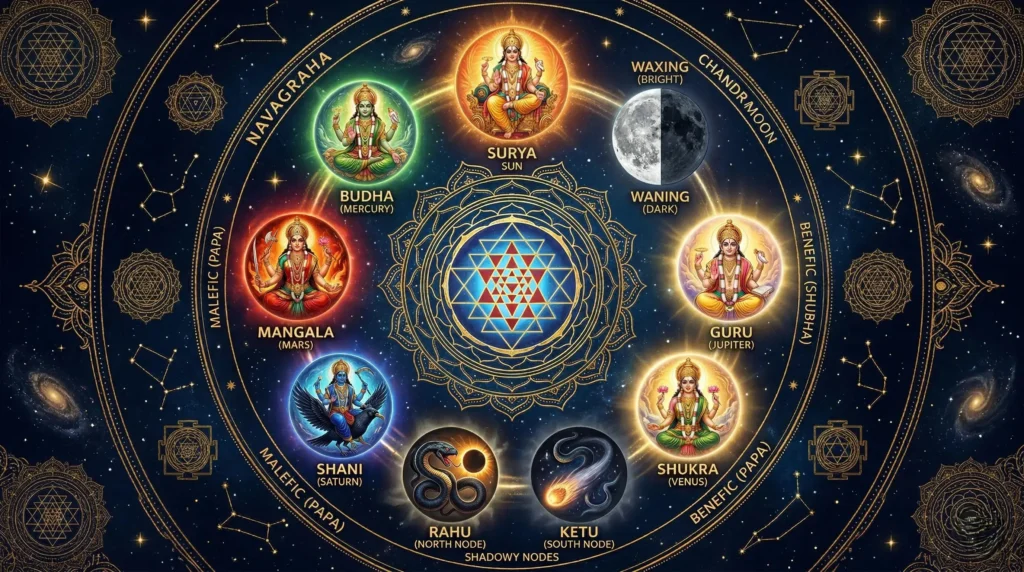
Natural Benefic & Malefic Planets in Vedic Astrology
A complete guide to Shubha and Papa Grahas — who they are, why they behave the way they do, and what truly determines whether a planet helps or harms you.
⚡ Quick Summary — Navagraha at a Glance
Shubha & Papa — Understanding the Terminology
From the elevated perspective of Vedic philosophy and Advaita Vedanta, existence itself transcends the duality of “good” and “bad.” The Navagrahas — the nine celestial forces of Jyotish — are best understood not as judges but as cosmic messengers. Each one delivers your accumulated karma at precisely the moment it is due.
Yet for the practice of Jyotish, we need clear working definitions. When a planet’s influence tends to produce happiness, growth, harmony, and the fulfilment of dharma, we call it a benefic. When its influence tends to create disruption, loss, or suffering, we call it a malefic.
One vital distinction: the natural classification described here is fixed and intrinsic to each planet — it never changes. This is separate from the concept of Functional Benefics and Malefics, which shift depending on your Ascendant (Lagna) and change from chart to chart.
“The planets are neither good nor evil in the ultimate sense — they are the instruments of karma, delivering what we have already earned.”
The Nine Planets (Navagraha) of Jyotish
Jyotish works exclusively with the Navagraha — nine specific celestial bodies. Unlike Western astrology, it does not use the outer planets Uranus, Neptune, or Pluto, nor asteroids such as Chiron. The reason is philosophical: Jyotish operates on the level of information fields rather than purely physical forces. The nine grahas, distributed across the Sidereal Zodiac (Nirayana) and the 27 Nakshatras, contain all the information needed for accurate karmic prediction.
The Navagraha comprise seven physical celestial bodies — Sun, Moon, Mercury, Venus, Mars, Jupiter, and Saturn — plus two lunar nodes: Rahu (North Node) and Ketu (South Node). The nodes are not physical objects; they are mathematical intersection points between the Moon’s orbital plane and the ecliptic. Their physical non-existence makes their karmic power no less real in the chart.
Complete Navagraha Classification
The table below provides the natural benefic/malefic classification of all nine planets, with the conditions and key notes that every Jyotish student must understand.
| Planet | Sanskrit Name | Classification | Key Notes |
|---|---|---|---|
Jupiter Guru / Brihaspati |
Guru | Natural Benefic | Unconditional benefic; wisdom, dharma, children, fortune |
Venus Shukra |
Shukra | Natural Benefic | Beauty, relationships, material pleasure and prosperity |
Moon (Waxing) Shukla Paksha |
Chandra | Natural Benefic | Growing towards Full Moon; auspicious for mind and emotions |
Moon (Waning) Krishna Paksha |
Chandra | Mildly Malefic | Classical texts often use Ashubha (“not auspicious”) rather than fully malefic |
Mercury Budha |
Budha | Conditional | Benefic with benefics; malefic with malefics — always examine its company |
Sun Surya |
Surya | Krura (Fierce) | Not a standard malefic; causes combustion (Asta) of nearby planets |
Mars Mangala / Kuja |
Mangala | Natural Malefic | Aggression and conflict by nature; when strong, gives courage and drive |
Saturn Shani |
Shani | Natural Malefic | Special case — strength brings integrity; even so, its periods can be challenging |
Rahu North Node |
Rāhu | Natural Malefic | Obsession, illusion, sudden disruptions; amplifies whatever it touches |
Ketu South Node |
Ketu | Natural Malefic | Detachment, past-life karma; brings spiritual breakthroughs or sudden loss |
Planet-by-Planet Analysis
Jupiter & Venus — The Great Benefics
Jupiter (Guru) and Venus (Shukra) are universally recognised as natural benefics in both Vedic and Western astrology. Jupiter expands whatever it touches — knowledge, wisdom, dharma, children, and fortune. Venus brings harmony, beauty, sensual pleasure, and material comfort. Both are capable of conferring significant grace on the houses they occupy or aspect, particularly when dignified and strong.
Mars & Saturn — The Natural Malefics
Mars (Mangala) and Saturn (Shani) are the two primary natural malefics. Mars governs aggression, conflict, ambition, and physical injury. Saturn governs discipline, karma, loss, delay, and grief. Both are capable of bringing hardship — yet both carry deeply constructive potential when well-placed and strengthened (see the Modifying Factors section below).
The Sun — Krura, Not Malefic
Western astrologers are often surprised to learn that the Sun is not classified as a natural benefic in Jyotish. Due to its blazing solar heat, the Sun is described as Krura — fierce or cruel. The primary concern is combustion (Asta): planets that fall within close orb of the Sun in the birth chart are overpowered and weakened. A combust Venus loses much of its ability to bring harmony; a combust Jupiter struggles to confer wisdom and prosperity. The Sun itself can be highly auspicious — it is the natural Atmakaraka, significator of the soul — but its presence needs to be managed carefully in chart interpretation.
The Moon — Waxing or Waning?
The Moon’s classification in Jyotish is entirely phase-dependent. A waxing Moon (Shukla Paksha) — growing from New Moon towards Full Moon — is a natural benefic. A waning Moon (Krishna Paksha) — declining from Full Moon towards New Moon — is at least mildly malefic, though many classical authors prefer the softer term Ashubha (“not auspicious”). The Full Moon is considered highly auspicious; the New Moon (Amavasya) is the most challenging lunar phase.
Mercury — The Chameleon
Mercury (Budha) occupies a unique position among the Navagraha: it has no fixed nature. When Mercury associates with (is conjunct or aspected by) natural benefics like Jupiter or Venus, it behaves beneficially. When associated with natural malefics like Saturn or Mars, it turns malefic. This makes Mercury’s role in any chart highly context-dependent — always examine which planets are in Mercury’s company before interpreting its results.
Rahu & Ketu — The Shadow Planets
Rahu and Ketu have no physical mass — they are calculated points where the Moon’s orbit crosses the ecliptic. Yet their influence in a Jyotish chart is among the most powerful and unpredictable. Both are classified as natural malefics. Rahu amplifies desire, creates confusion, and produces obsessive or unconventional results. Ketu detaches, dissolves, and surfaces unfinished past-life themes. Critically, both nodes can also produce exceptional outcomes: Rahu can bring worldly success through unorthodox paths; Ketu can accelerate spiritual liberation.
Modifying Factors — Planetary Strength Changes Everything
Knowing that Jupiter is a natural benefic tells you its intention. Whether it can actually deliver on that intention depends entirely on its Bala (strength) in your specific birth chart. Planetary strength is the single most important modifying principle in Jyotish interpretation — and it is the one most frequently overlooked by beginners.
✦ Strong Natural Benefic
An exalted or own-sign benefic (e.g. Jupiter in Cancer or Sagittarius, Venus in Pisces or Taurus) is at its most powerful — fully capable of delivering prosperity, wisdom, and harmony through the houses it governs.
✦ Weak Natural Benefic
A debilitated or combust benefic (e.g. Jupiter in Capricorn, Venus near the Sun) is severely limited — it intends to give but lacks the capacity. This is one of the most common sources of unmet chart promises.
✦ Weak Natural Malefic
A debilitated malefic is the most dangerous combination in Jyotish. It cannot channel its intense energy constructively and tends to cause the greatest damage to the houses it occupies or aspects.
✦ Strong Natural Malefic
A dignified malefic can express its constructive dimensions: a strong Mars gives leadership and courage; a strong Saturn gives endurance and integrity. Strength redeems even the most challenging planets.
Key Strength Positions to Know
The classical system of Shadbala (“six strengths”) provides a precise numerical measure of planetary power. For practical interpretation, these are the most important single-factor positions:
- Exaltation (Uccha Rashi): Maximum strength — each planet has one sign of exaltation
- Own Sign (Swakshetra): Very strong — the planet rules this sign and feels at home
- Moolatrikona: Slightly less than own sign but still powerful (unique to each planet)
- Debilitation (Neecha Rashi): Minimum strength — the sign directly opposite exaltation
- Combustion (Asta): Weakened by proximity to the Sun, typically within 6°–8°
- Retrograde (Vakri): Complex — retrograde planets behave with heightened intensity
Frequently Asked Questions
What is the difference between a Natural and a Functional Benefic?
Is the Sun ever beneficial in a birth chart?
How do I know whether the Moon was waxing or waning at my birth?
Can a malefic planet give genuinely good results?
Why doesn’t Jyotish use Uranus, Neptune, and Pluto?
Continue Learning

Toxic Mobile Number Combinations to Avoid
✦ Numerology · Mobile Number · Caution & Remedies Toxic Mobile Number Combinations You Should…

Lucky Mobile Number by Date of Birth | AstroPrasun
✦ Numerology · Mobile Number · Date of Birth Compatibility Lucky Mobile Number According to…

Is My Mobile Number Lucky? Check It | AstroPrasun
✦ Numerology · Mobile Number · Chaldean System Is My Mobile Number Lucky? How to…